Choosing the right commercial roofing material is one of the most important decisions a building owner can make. After all, your roof doesn’t only protect the people inside the building. It also has a major impact on how well the building performs in terms of wear and tear and energy efficiency.
This guide breaks down the commercial roofing materials that are most commonly used in the US. For your convenience, we’ve ranked the materials in order from most popular to least popular.
Note that just because a material is popular, it doesn’t automatically mean it’s the right fit for your roof.
Top 7 Commercial Roofing Materials in the US
The following table summarizes the pros and cons of the 7 roofing materials that are most commonly used on commercial buildings in the US.
Materials are listed in order from most popular to least popular. The numbers listed for lifespan assume that your roof is properly maintained.
| Material | Used for | Lifespan | Energy Efficiency | Cost |
|---|---|---|---|---|
| Single-Ply | Flat & low-slope roofs on offices, warehouses, retail and industrial buildings | 20–30 years | Good | $$ |
| Metal | Warehouses, manufacturing facilities, retail centers | 40–70 years | Good | $$$ |
| Modified Bitumen | Low-slope commercial roofs requiring durability | 15–25 years | Poor | $$ |
| BUR | Older commercial buildings, roofs with frequent foot traffic | 20–30 years | Poor | $$ |
| Shingles | Sloped roofs, small commercial buildings, mixed-use properties | 20–40 years | Average | $–$$ |
| SPF | Roofs needing seamless insulation | 25–40 years | Excellent | $$–$$$ |
| Green | Buildings focused on sustainability | 40–60 years | Excellent | $$$$$ |
Let’s look at each of these materials in more detail.
1. Single-ply
The most commonly used commercial roofing material in America is single-ply.
Single-ply roofs are made from a single plastic or rubber sheet, engineered to be lightweight, fire-proof and resistant to the elements. They’re easy to both install and maintain.
These roofs come in different thicknesses. The thicker the material, the more durable it is, and the longer the manufacturer warranty generally lasts for.
Although widely used, single-ply roofs are not especially pleasing to the eye. They’re also susceptible to breaking if workmen frequently walk on the roof or drop tools on it.
There are three types of single-ply roof: TPO, PVC and EPDM.
TPO
TPO, or thermoplastic polyolefin, is by far the most popular commercial roofing material in the country, accounting for 40% of the market.
A TPO roof is made of polypropylene and ethylene-propylene rubber, reinforced with a polymer mat. To make the roof, 3 layers of this material are heat-welded together. The top layer is engineered to be exceptionally resistant to UV rays and heat, and also resists mold, dirt and chemical corrosion.
TPO is available in white, gray and tan. The lighter the color chosen, the better TPO is at reflecting heat and keeping AC costs down, but the harder it is to clean.
Note that the quality of TPO varies by manufacturer. If you purchase from a less reputable supplier, your TPO will age more quickly, often showing signs of seam damage.
PVC
Like TPO, PVC (polyvinyl chloride) is a thermoplastic roof that consists of three layers of reinforced plastic. The top and bottom layers are PVC, and the middle layer is polyester. The top layer is designed to be resistant to UV light, while the bottom layer is engineered to be flexible.
PVC is just as reflective as TPO, but even more impermeable. It’s resistant to chemicals, animal fats, oils, bacteria, mold, moisture, wind and fire. This makes it a good fit for restaurants and factories.
That being said, consider that PVC is the most expensive of the single-ply roofs. It’s also prone to shrinking or becoming brittle in colder climates.
EPDM
EPDM (ethylene propylene diene monomer) is a single-ply roofing material that’s made from rubber. Whereas other single-ply materials are heat-welded together, EPDM is glued or seam-taped.
Like other single-ply roofs, EPDM is durable and resistant to the elements. It has two advantages over TPO and PVC. It’s resistant to acids, solvents and alcohol, and it’s also more environmentally friendly.
However, since EPDM is normally black, it’s prone to absorbing heat – unless you coat it with an expensive reflective finish. It’s also more likely to face punctures than other single-ply options.
2. Metal
The second-most popular commercial roofing material is metal.
Metal roofs are extremely resistant to fire and UV rays, and quite resistant to the elements. They’re also 100% recyclable and great for saving your business money on energy bills.
Metal roofs are much more durable than single-ply ones, and can last up to 70 years if properly maintained. They’re also more aesthetically pleasing, coming in various colors, textures and styles. The most popular metals used are:
- Steel: often coated in zinc to reduce corrosion
- Aluminum: the most expensive option, but also the one that’s most energy-efficient and has the longest warranty
- Galvalume: aluminum-coated steel, cheap but often gets scratched during installation
The downside of metal roofs is that they’re prone to corrosion, especially in coastal areas, unless you cover them with an expensive coating. Untrained personnel can also sometimes slip on metal roofs when they’re wet.
There are two main types of metal roofs: standing seam and screw-down.
Standing seam
Standing seam roofs get their name from the fact that the fasteners are hidden, leaving only a visible seam between adjoining sheets of metal.
They’re exceptionally durable, even by the standards of metal roofs. They’re particularly good at protecting buildings from storms because they won’t fly off in the wind – which is handy in a region like Texas.
The cost of this durability is that standing seam roofs are more complicated and expensive to install than screw-down ones.
Screw-down
Screw-down roof panels are literally screwed onto the roof.
They’re cheaper and easier to install than standing seam roofs, and they provide a similar level of protection and curb appeal.
Since your metal roof will expand and contract with the weather, it’s likely that the screws will eventually come loose. So you’ll need to plan for more maintenance with a screw-down roof than you would with a standing seam one, every 5 years or so.
3. Modified Bitumen
A modified bitumen (mod bit) roof consists of layers of asphalt, polymers and fiberglass that are applied one by one, often in rolls.
Mod bit has become popular because it’s a convenient way to create a layered, asphalt roof without having to melt tar onsite at over 500 degrees, which is extremely dangerous. It can be installed using self-adhesive sheets, using heat welding, or with a cold adhesive.
A mod bit roof’s multiple layers make it both flexible and durable, and more resistant to foot traffic from workmen than many other types of roof. Mod bit also resists temperature swings to a degree that other roofs don’t.
The mod bit material itself is extremely cheap, but the labor costs can sometimes be quite high, since applying multiple layers takes time and requires a professional.
The life expectancy of a mod bit roof is only 15-25 years, which is less than the other roofs on this list. Because of its layered properties, maintenance is also quite challenging and expensive.
4. BUR
A built-up roof (BUR) is the type of roof that mod bit roofs were designed to replace. To install this roof, the roofer has to heat up asphalt to 500 degrees, pump it to the top of the building, and mop it onto the roof. Despite the dangers inherent in installation, BURs remain popular due to their high durability and fire resistance.
There are normally between 5-7 layers in a BUR. Most layers consist primarily of asphalt, with fiberglass and even ply sheets thrown in for extra strength. The top layer is the most important defence against the elements, so it’s typically reinforced by either rocks or roof granules so that the BUR needs less frequent maintenance and repairs.
The rough nature of the top layer gives BURs a particular character. It makes them extremely resistant to the elements, and sturdy enough to support a lot of foot traffic from workers. But it also makes it hard to locate leaks, since the gravel on top of the roof sometimes obscures damage. And the top layer is so heavy that a BUR needs to have sturdy understructures to support it, or else risk collapsing.
5. Shingles
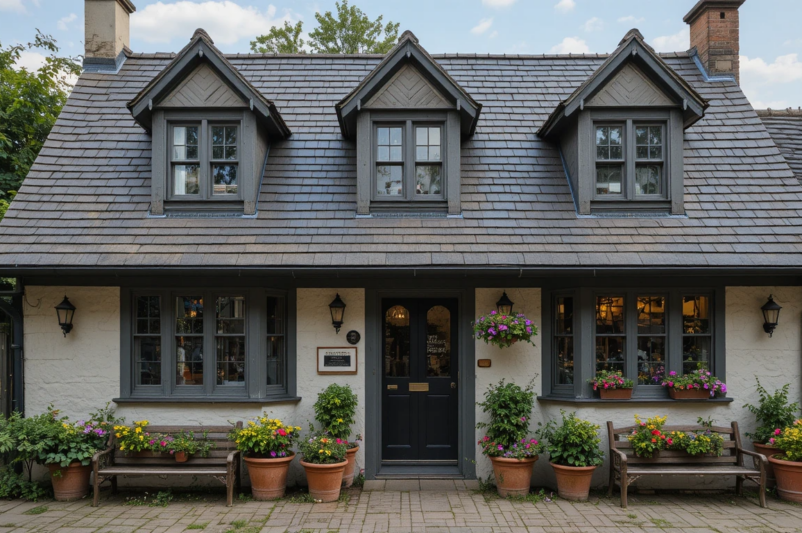
Asphalt shingles are best-known for their application on residential homes, but they’re also a popular option on commercial buildings, particularly those with a slanted roof.
Shingles are made of a fiberglass mat that’s coated with asphalt to make it waterproof. The top layer of each shingle is infused with stone granules, which add both UV protection and curb appeal.
The three main types of asphalt shingles are 3-tab shingles, architectural shingles and designer shingles.
Of the three, designer shingles are by far the most popular on commercial buildings, because the other types provide minimal wind protection and need replacing every decade or so. Designer shingles will give you a durable roof that’s pretty to look at, at a budget-friendly price.
The only challenge with shingles is that they’re prone to falling off the roof, especially in the types of storms we get in Texas. They’re less durable in extreme weather conditions than a metal roof would be, for example. So they require frequent maintenance to prevent leaks.
6. SPF
To create this roof, the roofer applies a spray polyurethane foam (SPF) as a liquid that expands and forms a solid layer.
Since the SPF is applied as a liquid, it’s great for buildings with irregular-shaped roofs, or older buildings that have a few leaks and tears. The SPF is highly flexible and will adhere to any contoured surface, forming a seamless barrier against the elements.
SPF roofs naturally reflect light, which is great for energy efficiency. If the energy efficiency ever starts to suffer later in the roof’s life, it’s fairly easy to just spray a new coat. Maintaining an SPF roof is very straightforward.
However, if the SPF layer is applied in an irregular fashion, the performance of the roof can system. It really needs a uniform thickness to be completely impermeable. There are also fewer color and style options with SPF roofs than there are with shingles or metal, for example.
7. Green
To create a green roof, add soil and layers of plants over a waterproof membrane. The result is a space that looks more like a garden than a roof, creating a place where employees and clients can relax from work.
Beyond being recreational spaces, green roofs also offer natural insulation together with protection from the elements. The many layers of a green roof serve to absorb heat and reflect light, making the green roof the most energy-efficient option on this list. The plants on the roof will also improve the air quality around your commercial building.
The biggest downside of a green roof is the cost required to install it, which can go up to $50 per square foot. You’ll probably need to install a special drainage system, which will likely require specialized equipment. Even after the roof is built, you’ll need to maintain it carefully to ensure the plants don’t overgrow – especially if clients go up there.
But the reward for the businesses that make the investment is huge. A green roof is a natural backdrop for advertising, as well as a great source of PR for companies who want to flout their sustainability credentials.
How to choose the right commercial roofing material for your organization
The right roof for you depends on a range of different factors. Here are the most important ones to consider.
Durability
This is perhaps the most important consideration in a region like Texas that’s known for its hailstorms. The last thing you want is for your commercial roof to blow off, or for your shingles to be lost in a storm.
The most durable roofs are metal (especially standing seam) and BUR. These perform well in adverse weather conditions and are also sturdy enough to withstand a large amount of foot traffic.
If you live in an area that’s prone to sunlight, a TPO roof is also worth considering. TPO is particularly good at reflecting UV rays, and the white versions are amazing at reflecting heat and light.
Energy efficiency
Green roofs are the most energy-efficient option, but not every organization can afford the cost of installing and maintaining one.
SPF is a worthy runner-up here, just because it reflects so much sunlight that it will reduce your energy bills. All the single-ply options are worth considering for the same reason.
Aesthetics
To determine the best option aesthetically, it’s sensible to look at the surrounding buildings and choose a material that blends in.
Green roofs, metal roofs and shingle roofs are all known for their curb appeal. By contrast, single-ply roofs and BURs are not especially pretty to look at.
Roof shape
Don’t underestimate the importance of the shape of your roof when selecting the material that’s covering it.
If you have a flat roof, go with single-ply, BUR or mod bit. If you have a sloped roof, shingle or metal will be a better fit.
Cost
To determine the most cost-effective option, you’ll need to weigh the one-off installment costs against the longer-term costs of maintenance and savings on energy bills.
The cheapest roof systems to install are shingles and mod bit.
If you’re seeing this as a long-term investment, a standing seam metal roof has the lowest maintenance costs and lasts the longest of any roofs on this list.
If sustainability is important to your brand, you might also factor in the PR value of having a green roof.
Other factors
Whichever roof type you choose, make sure that you inspect it regularly and maintain it carefully. The better you maintain it, the longer it will last, which will save you money in the long-term.
Also ensure that your roof comes with a warranty. Ideally, you’ll want two of these: a 10-year warranty on the materials and a warranty from the roofer that covers workmanship. You’ll need both for insurance purposes.
Final thoughts
If you’re still unsure which roofing material is right for your commercial building, we encourage you to get in touch with us.
We’ll gladly inspect your building for free, tell you which type of roof will work best and how much it will cost.
Call us on (210) 670-6890 today to schedule a free roof inspection.

About the Author
Certifications & Affiliations