
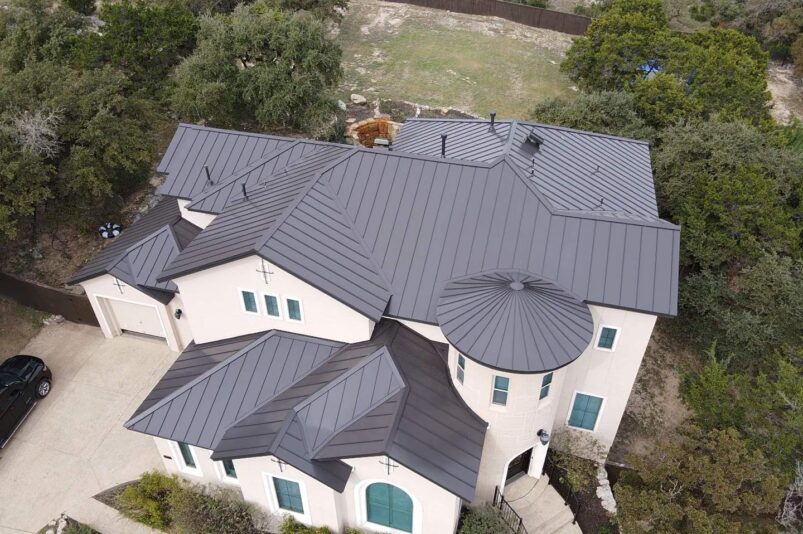
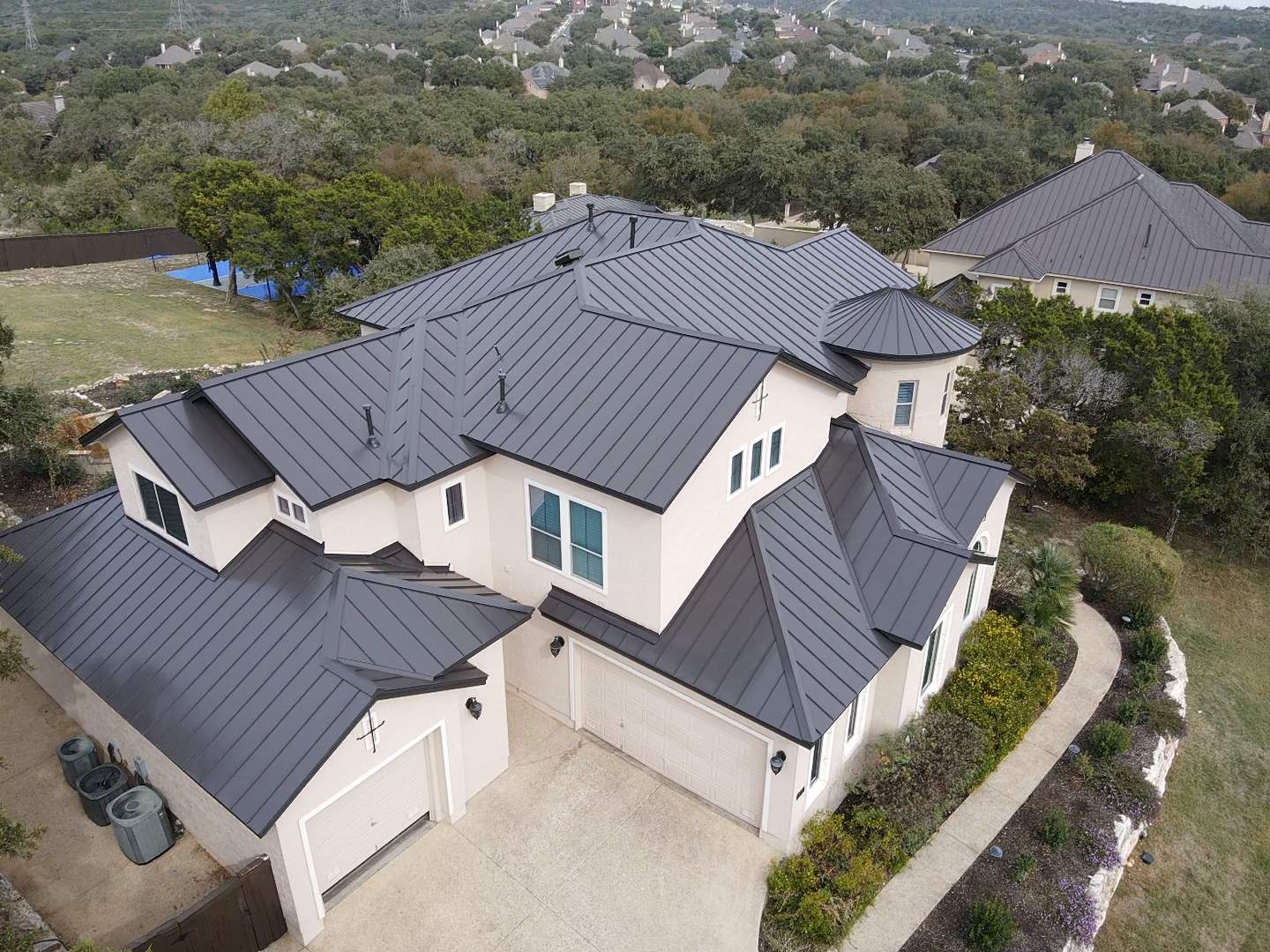
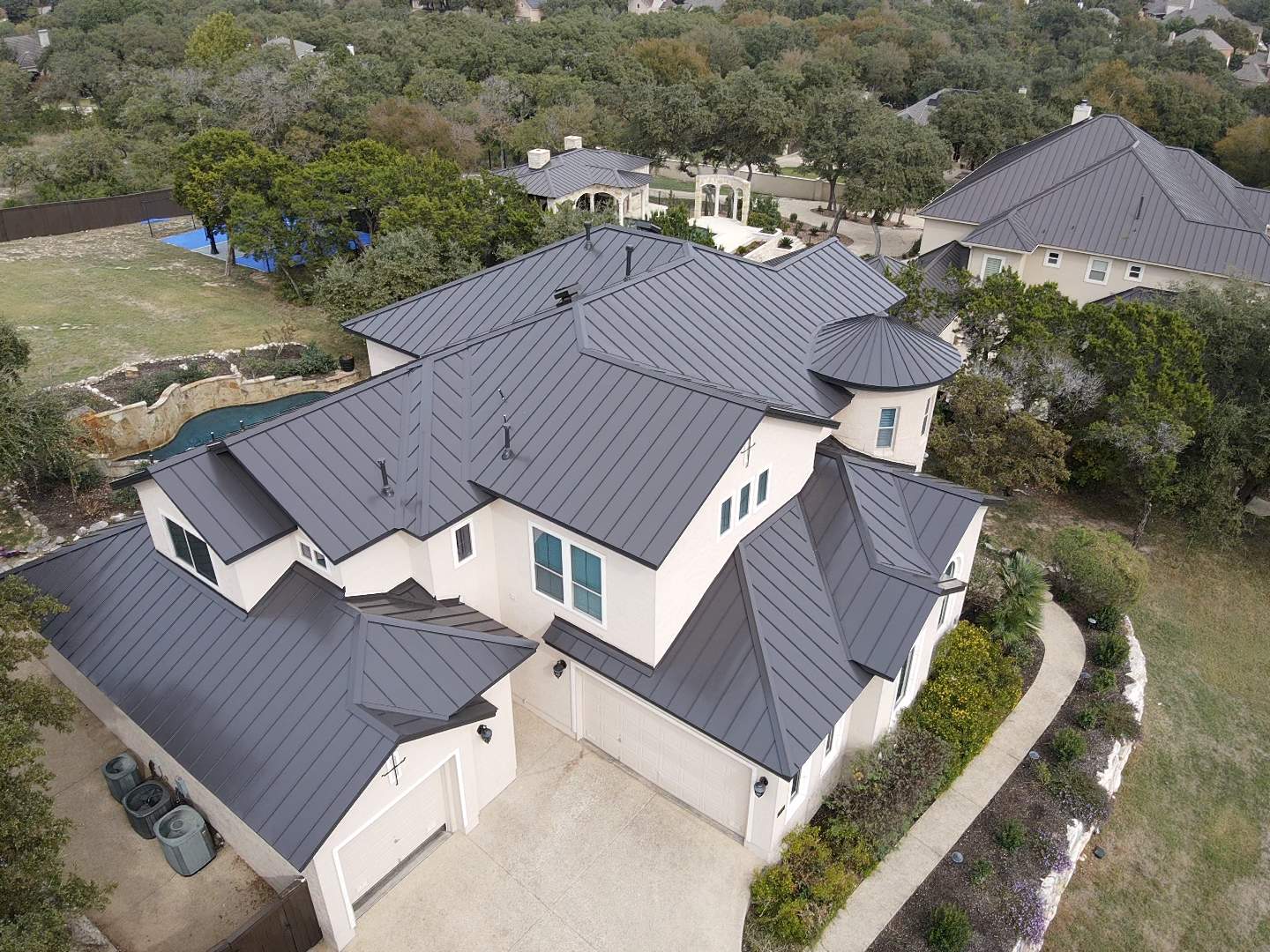
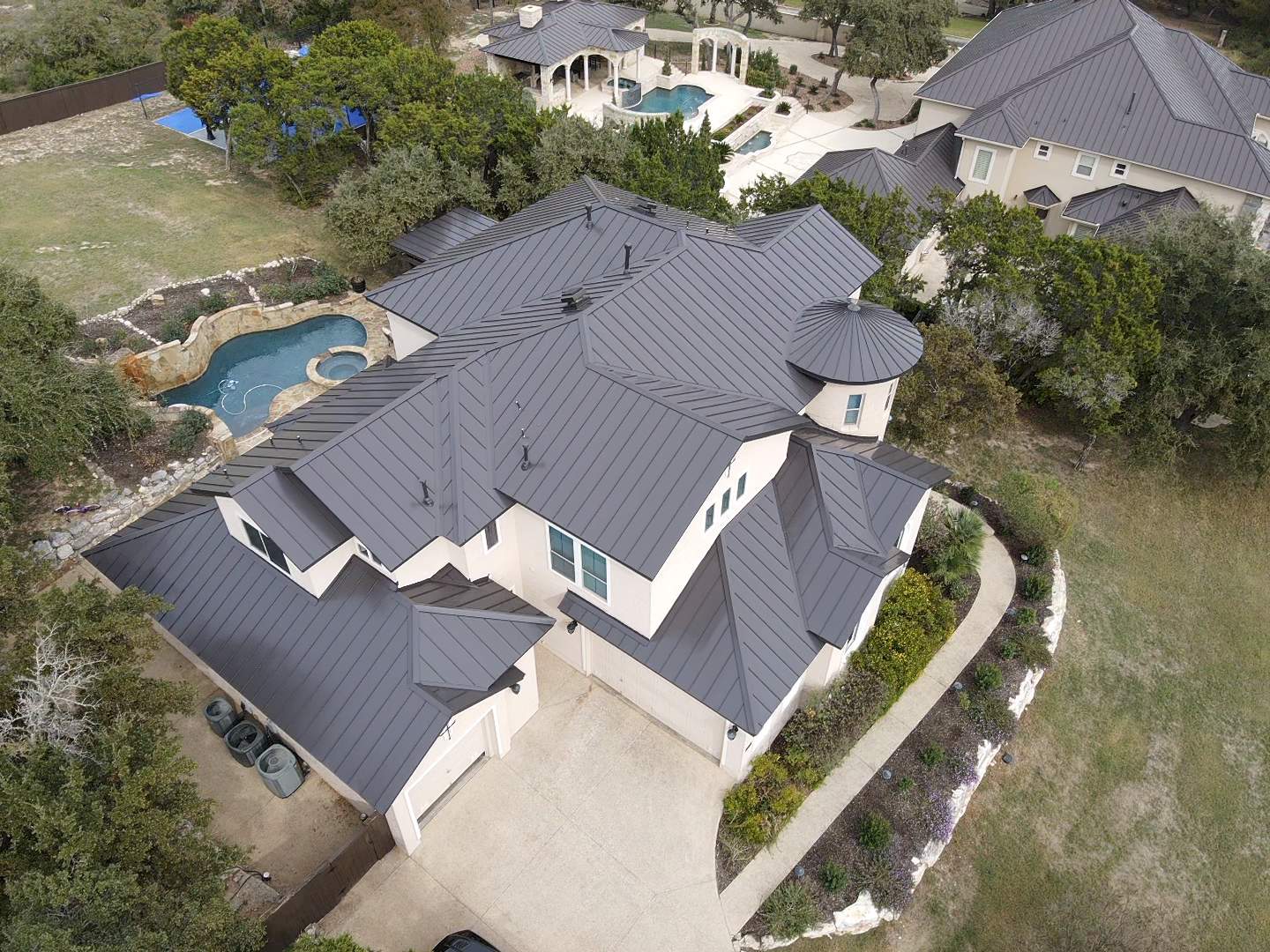
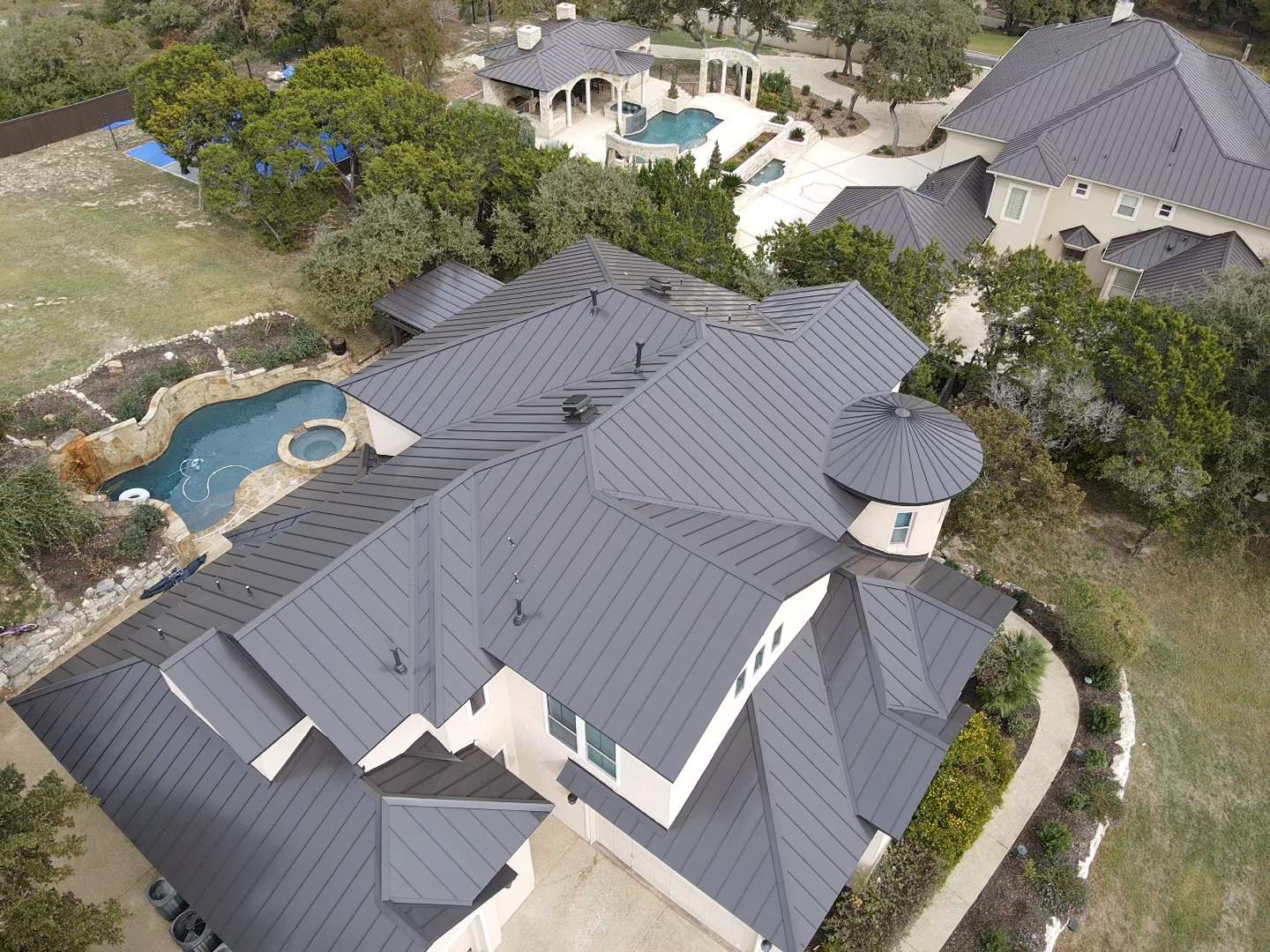
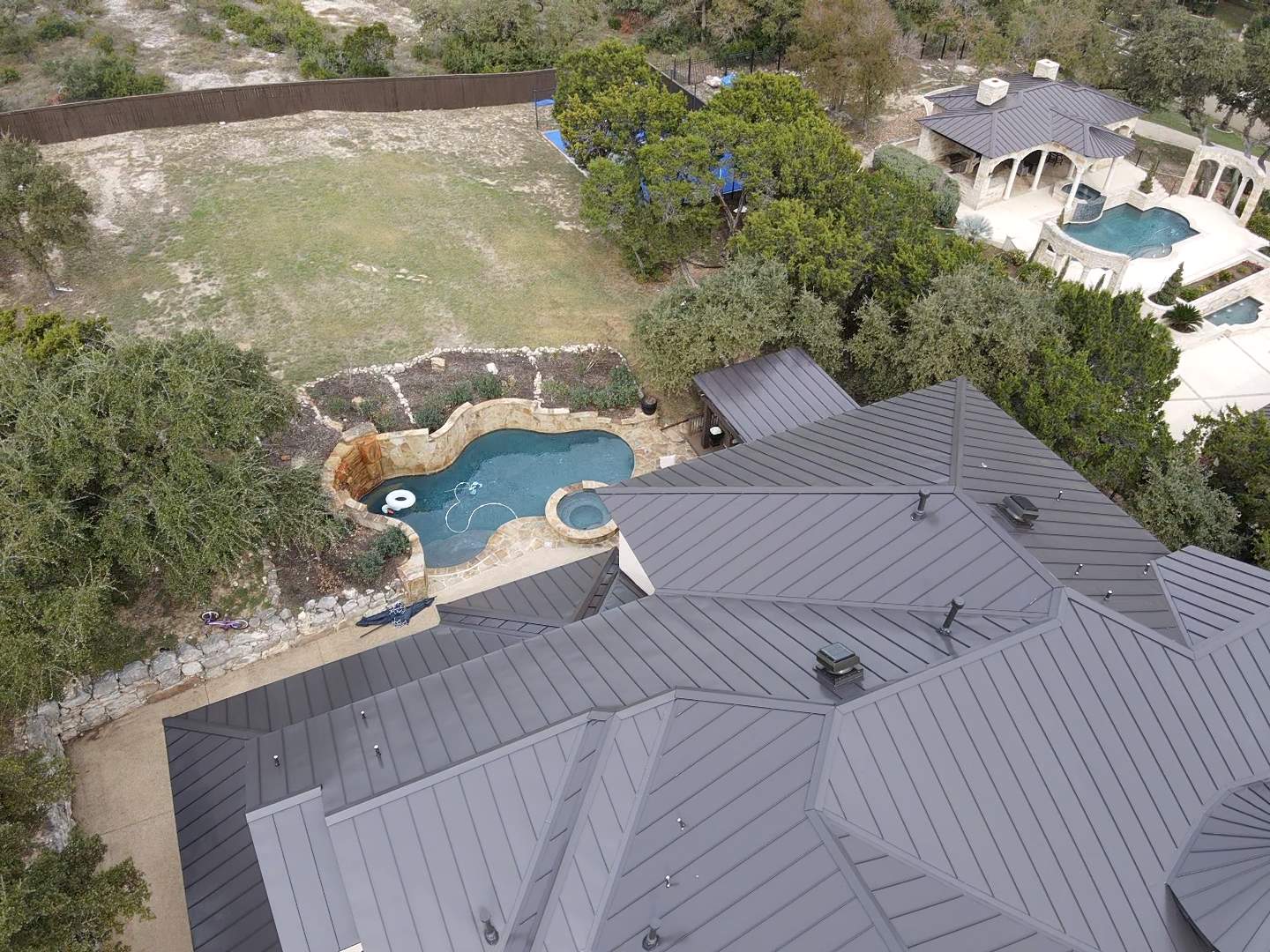
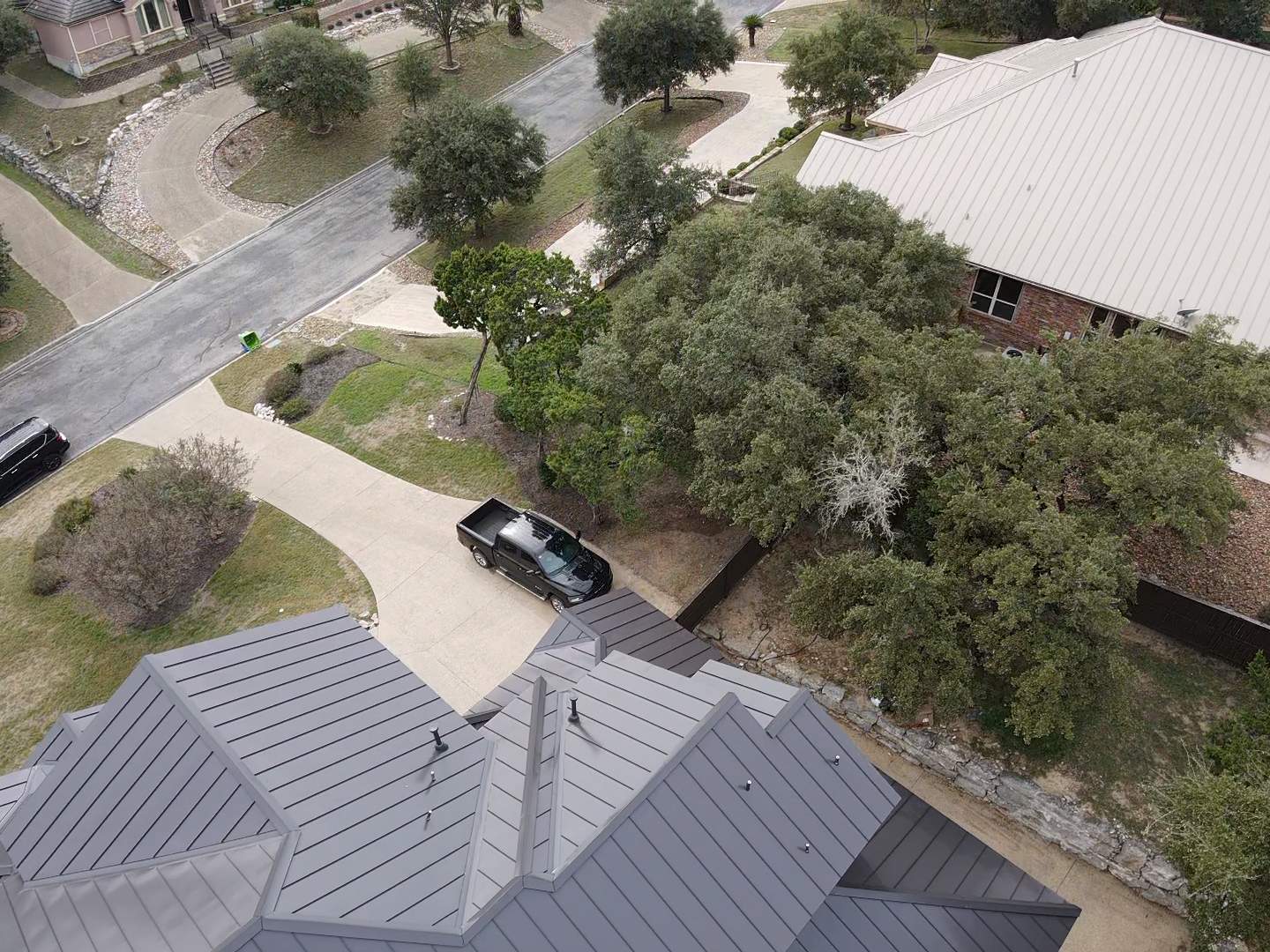
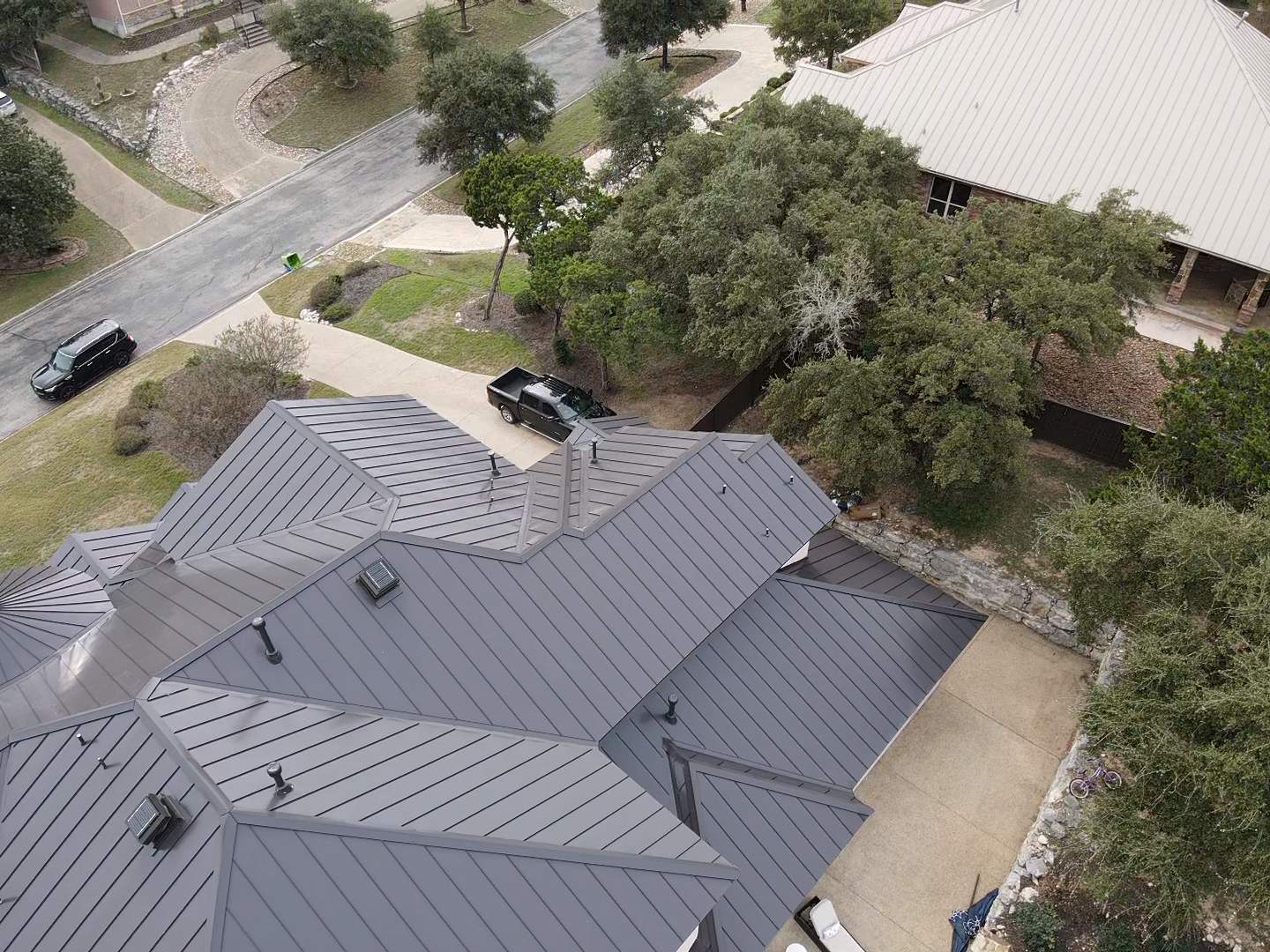
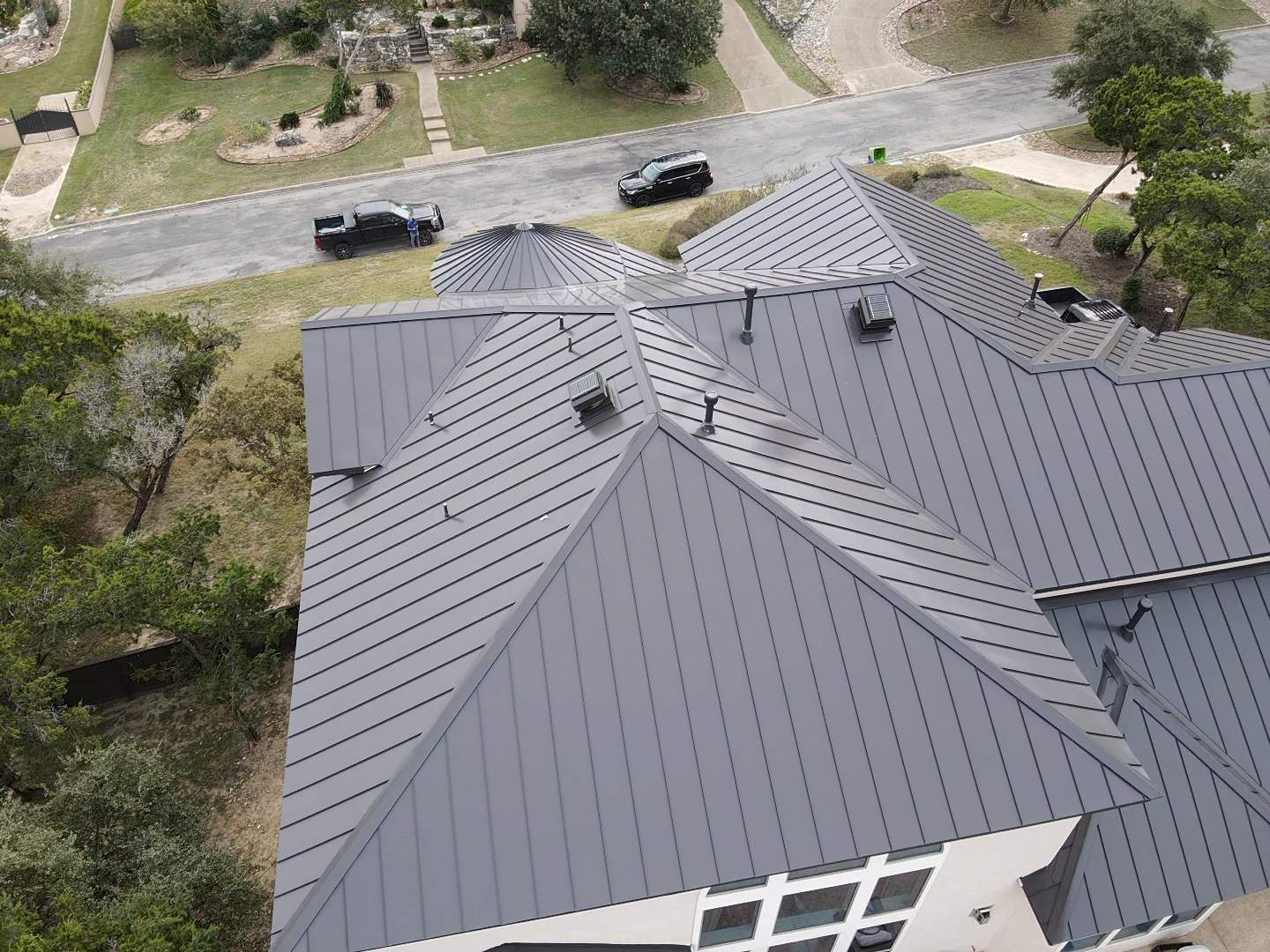
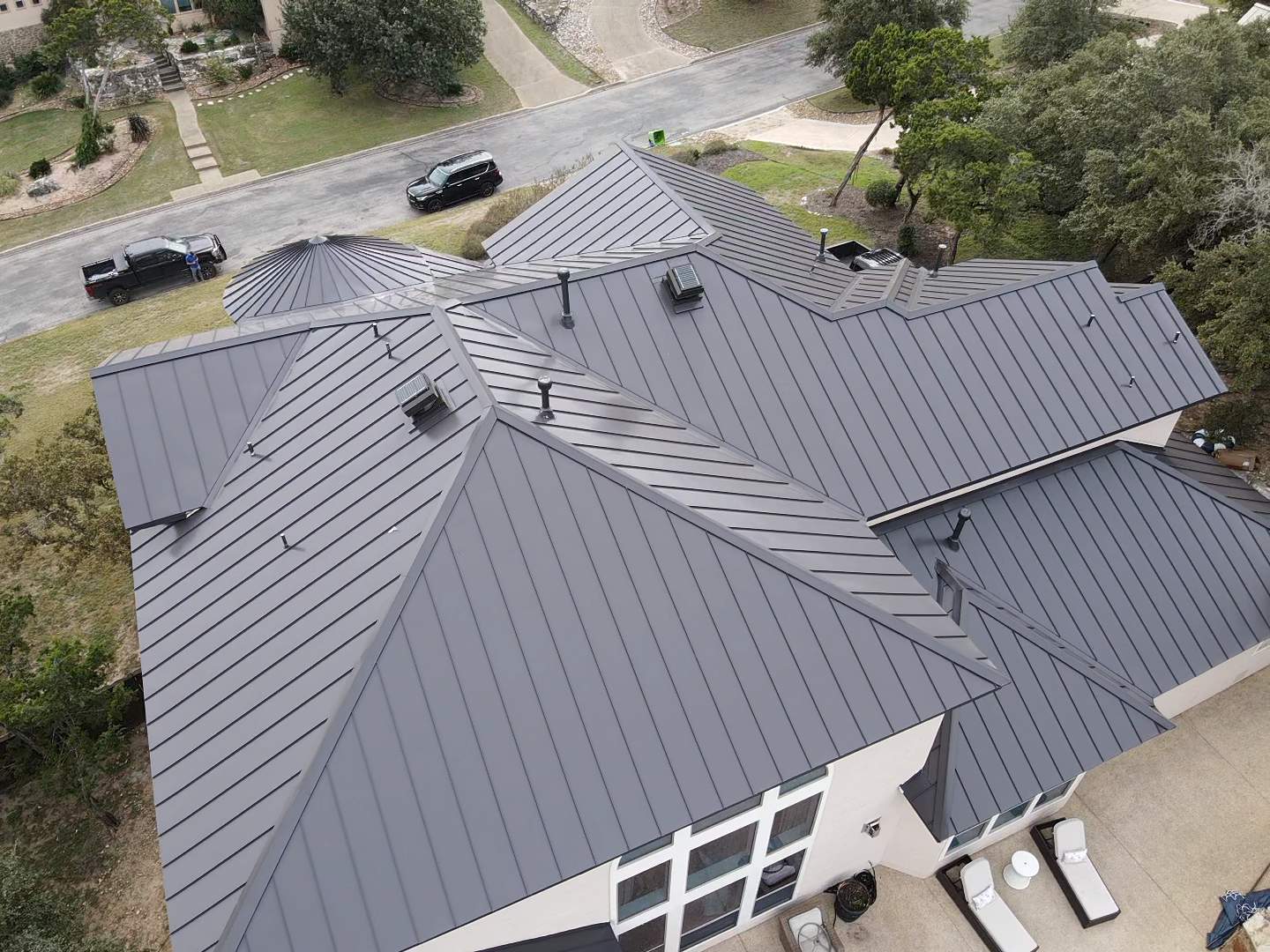
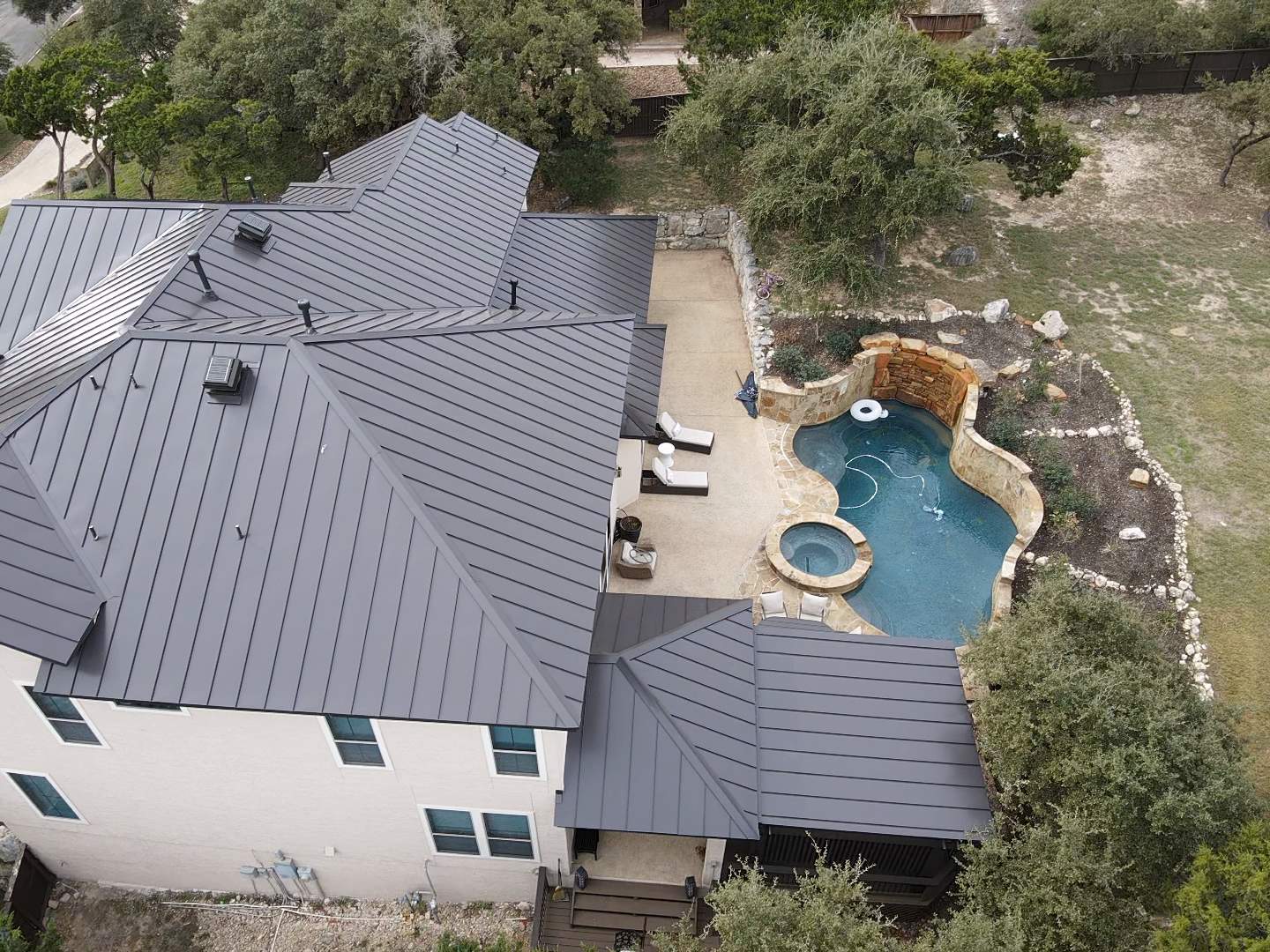
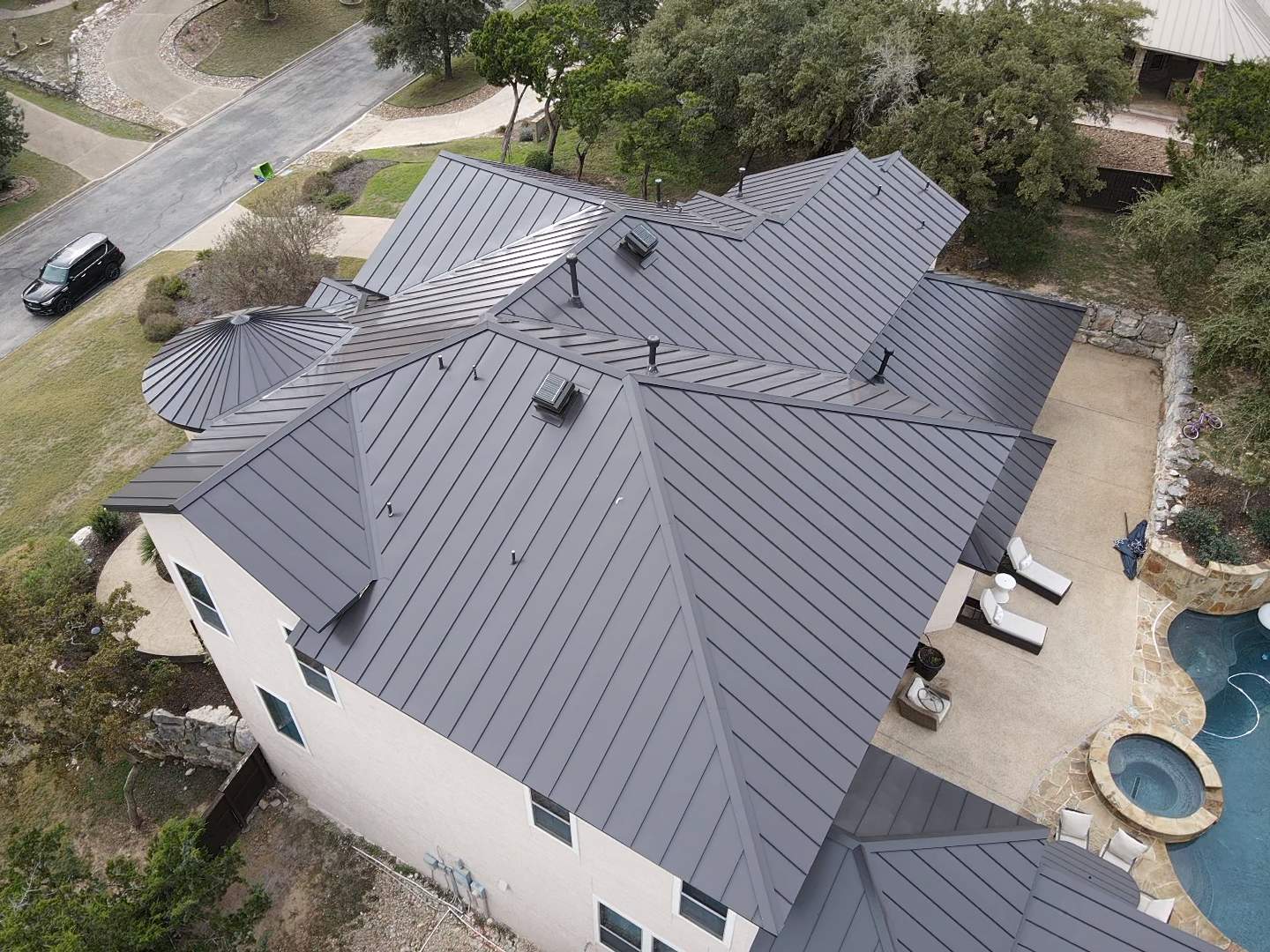
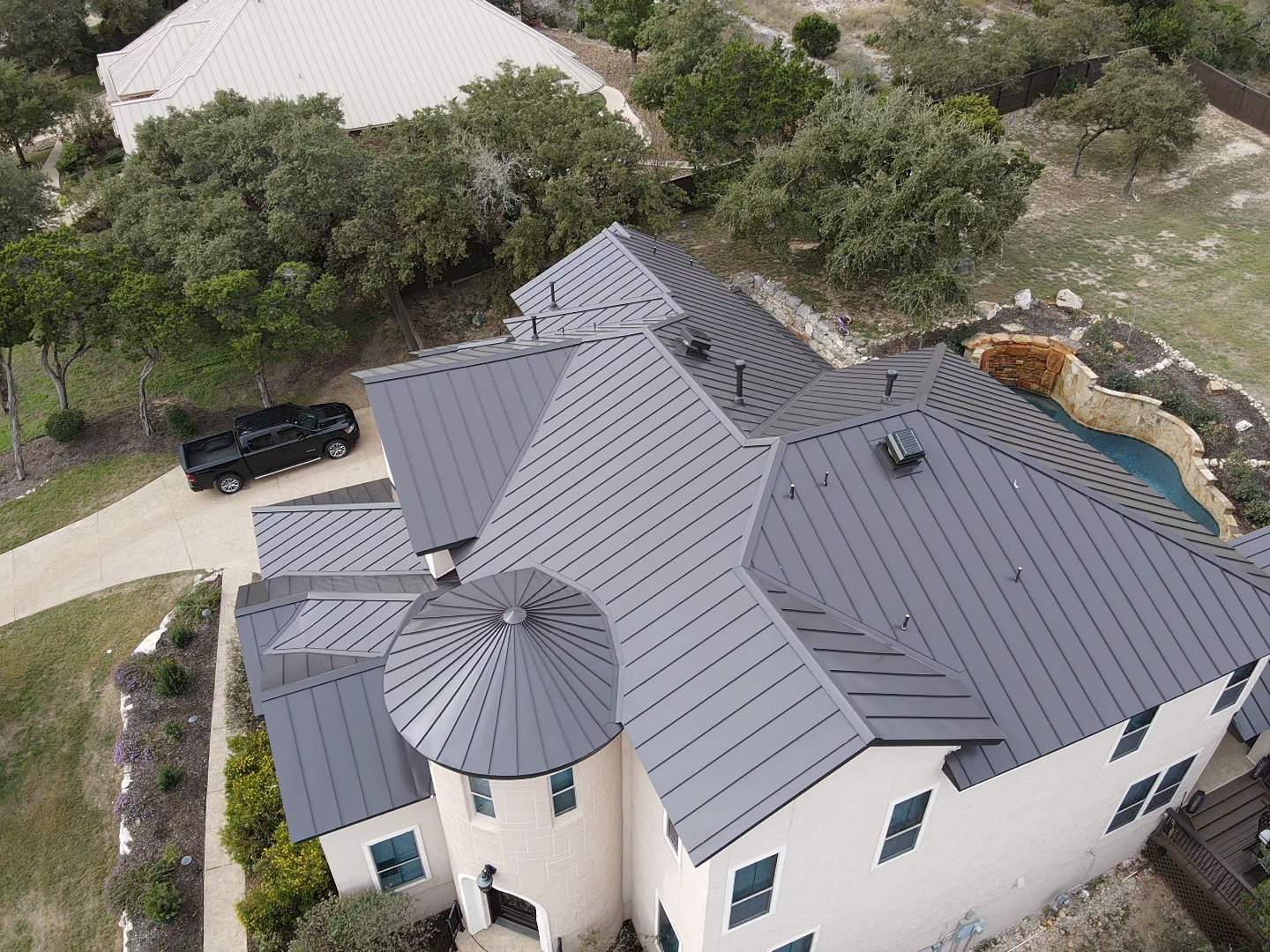
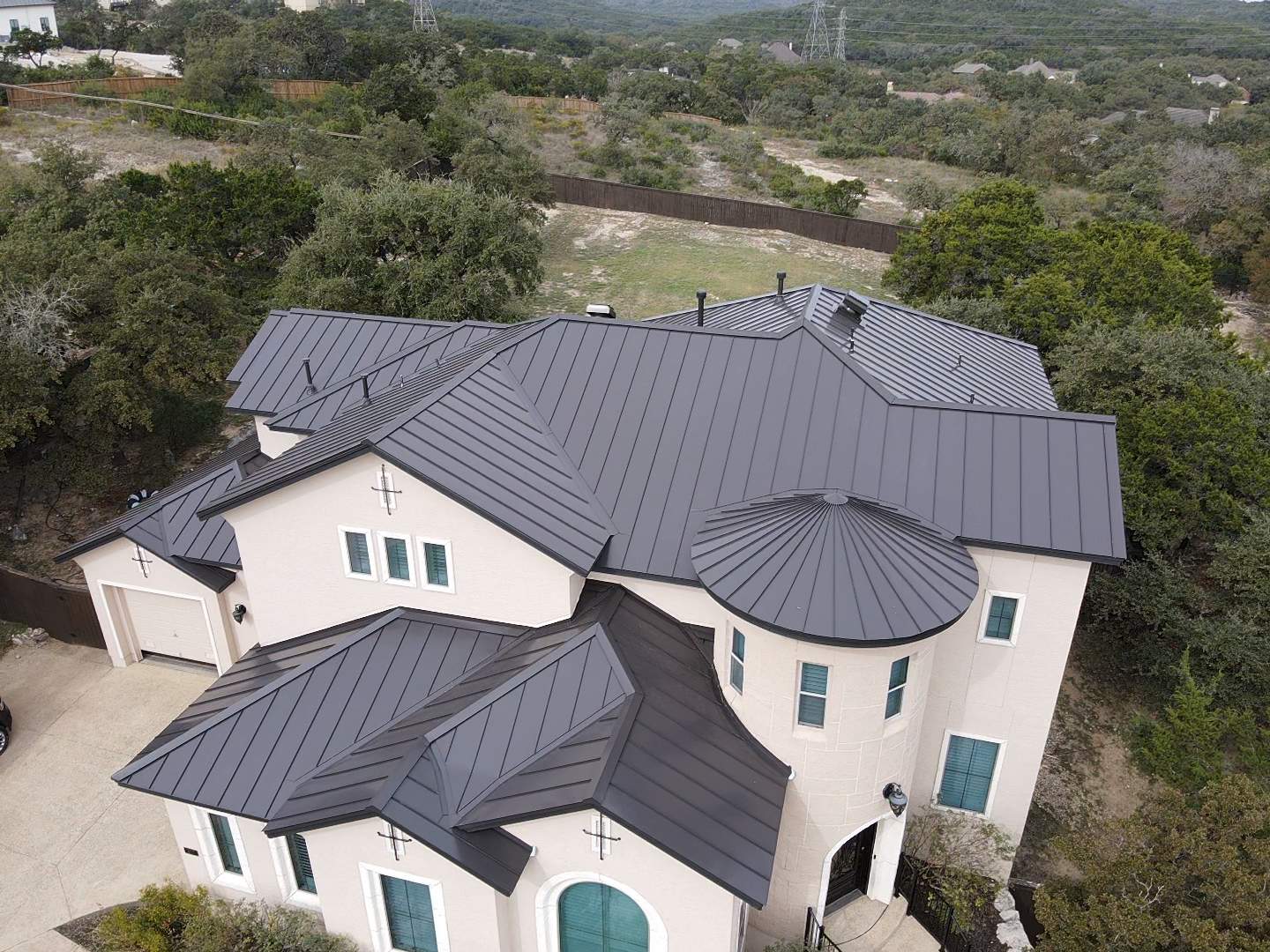
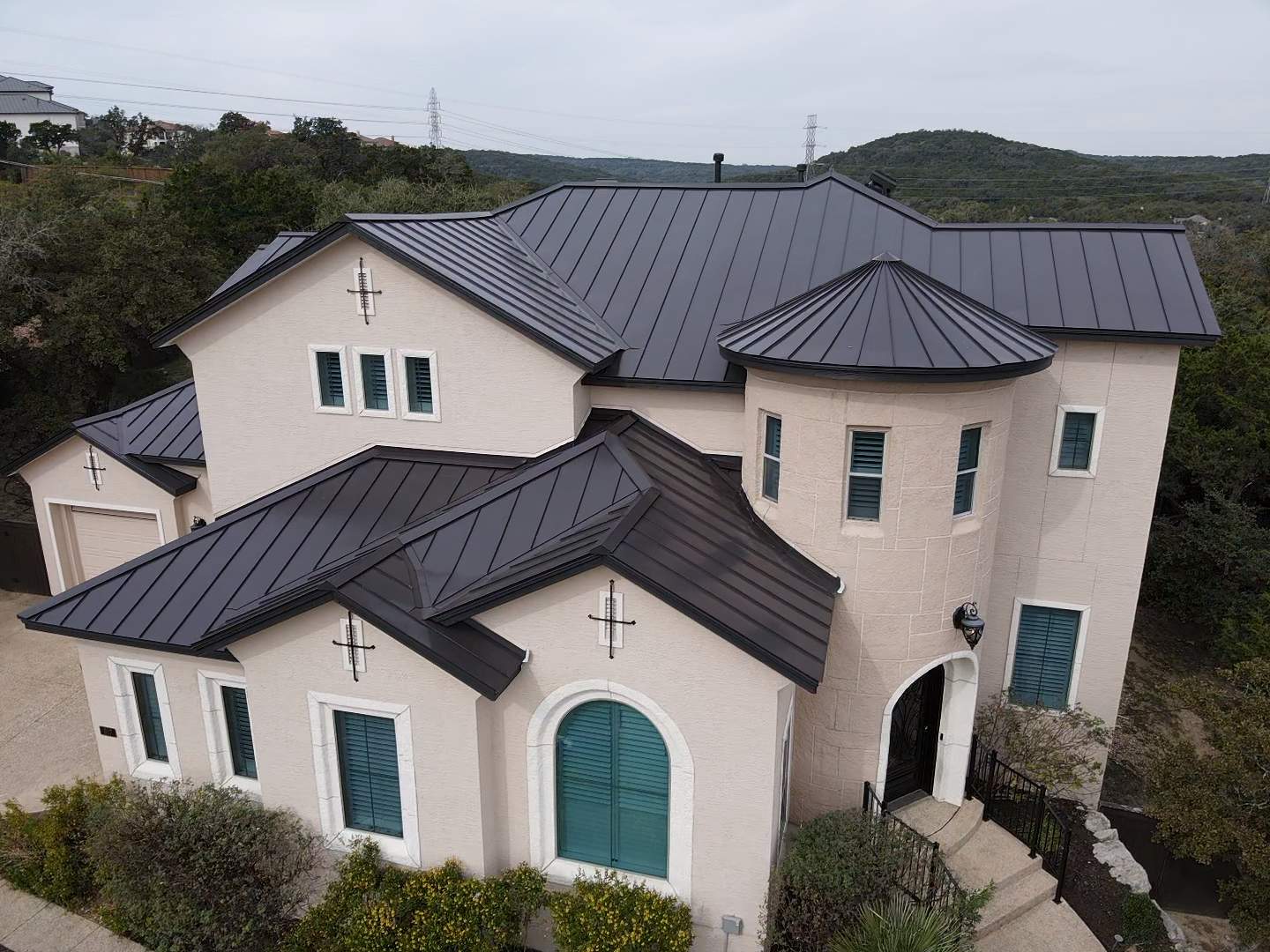
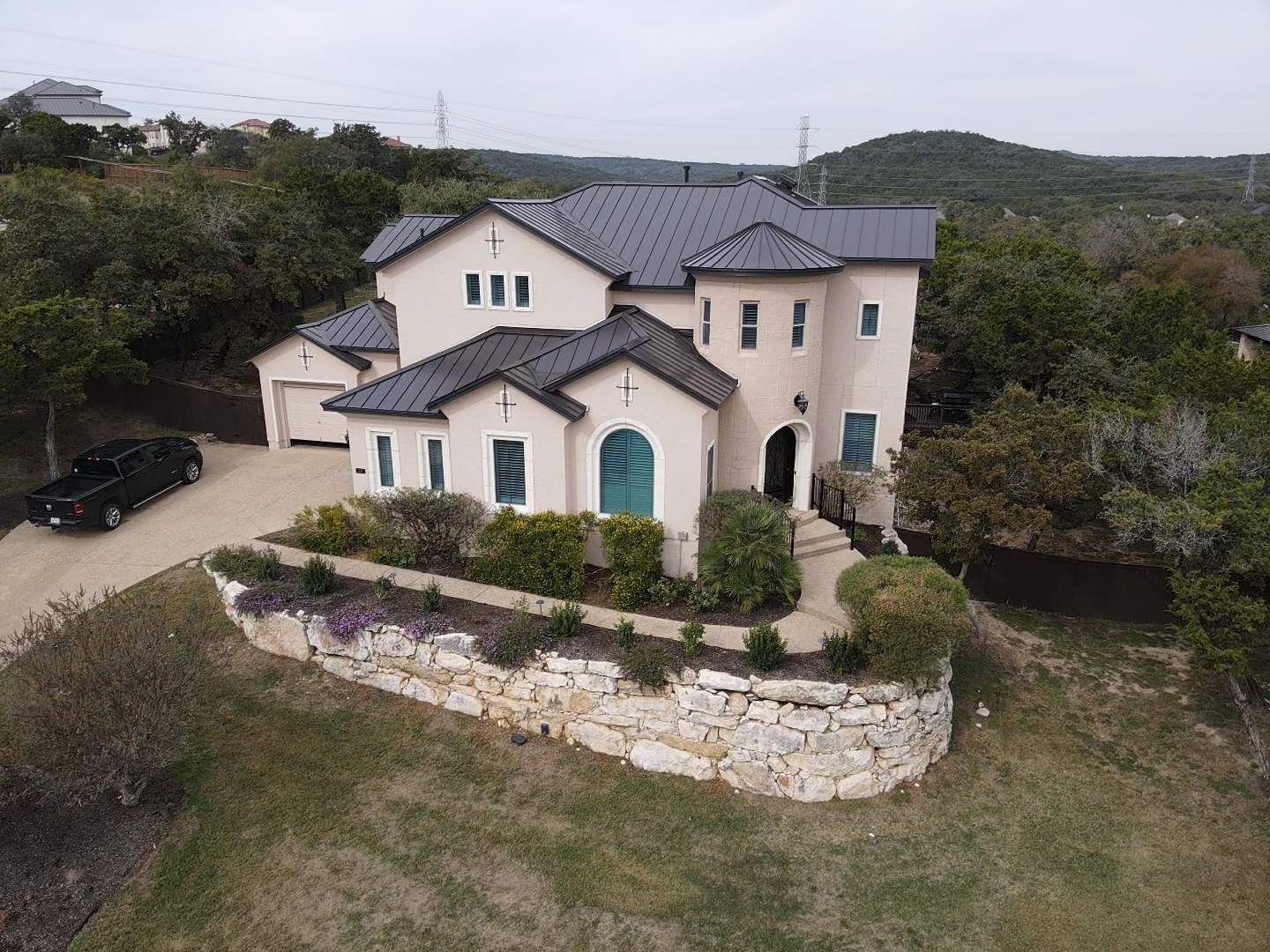
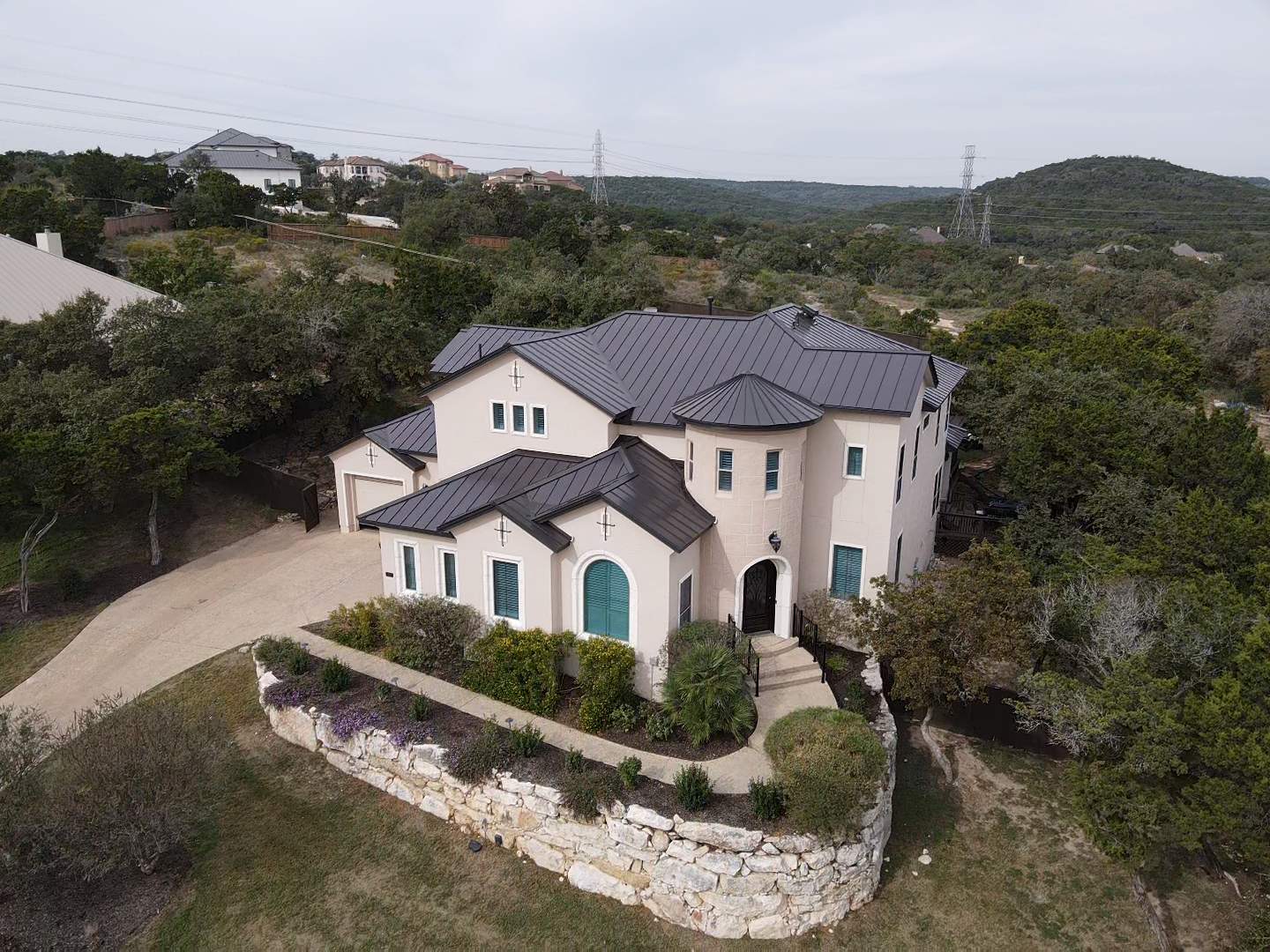
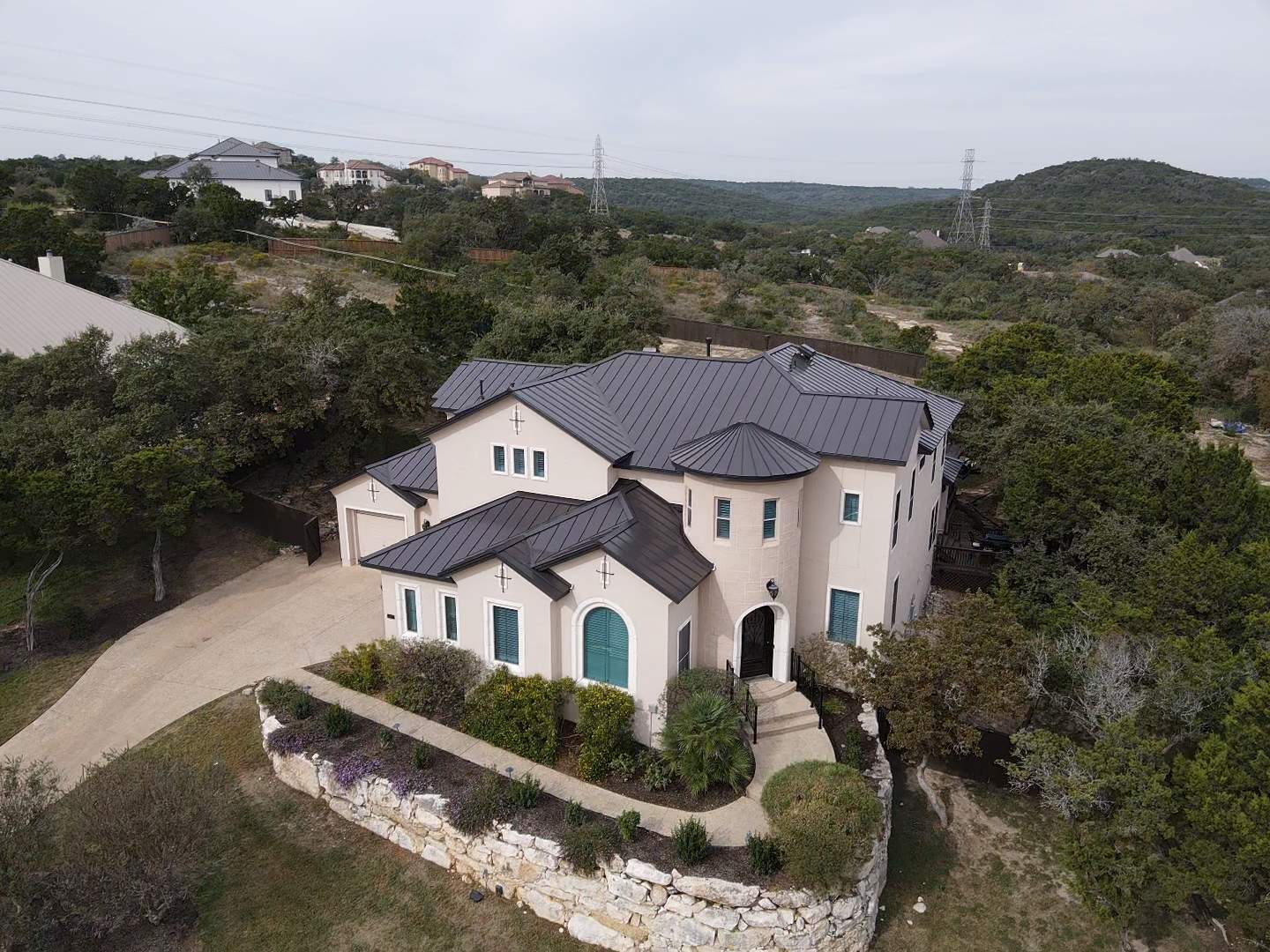
Presidio Roofing Company completed a full retail roof replacement on a two-story single-family home in the Sonoma Ranch neighborhood of Helotes, TX, converting 52 squares of existing concrete tile to a McElroy 24-Gauge Flat Profile 1.5″ Mechanically Fastened Standing Seam Metal roofing system. Scope covered full concrete tile tear-off, complete deck replacement with 5/8″ Radiant Barrier OSB sheathing, High Temp Ice & Water Shield across the entire deck, all standing seam trim and flashings, stucco contractor coordination to replace all counter and wall flashings behind the stucco facade, and installation of two Breeze Solar Powered attic vents. This retail replacement was valued at $100,000-$120,000, backed by a manufacturer warranty and a 10-year labor warranty, and completed over a 2-3 week on-site schedule.
In This Case Study:
- Project Snapshot: Key Specifications & Costs
- Introduction
- Work Scope
- Challenge 1: Managing a Tile-to-Metal Conversion Without Splitting the Job Between Two Separate Crews
- The Solution: A Single Crew With Cross-Trade Expertise in Both Tile and Metal
- Challenge 2: Moving 52 Squares of Concrete Tile Off a Two-Story Roof Safely
- The Solution: A 12,000-lb Genie Telehandler With Certified Operators and Direct On-Site Coordination
- Challenge 3: Flashing a Standing Seam Metal Roof Against a Stucco Facade Without Cutting Corners
- The Solution: Dedicated Stucco Contractor On Site to Restore Every Penetration Point
- The Result
- How to Maintain Your New Standing Seam Metal Roof
- Frequently Asked Questions About This Project
Video transcript and key highlights
Click to view video summary
Project Snapshot: Key Specifications & Costs
| Metric | Project Detail |
|---|---|
| Project Type | Full Roof Replacement (Residential, Retail) |
| Location | Sonoma Ranch, Helotes, TX 78023 |
| Roof Size | 52 Squares |
| Material Used | McElroy 24-Gauge Flat Profile 1.5″ Mechanically Fastened Standing Seam Metal |
| Duration | 2-3 Weeks On Site |
| Budget Range | $100,000 – $120,000 |
| Warranty | Manufacturer Warranty + 10-Year Labor Warranty |
Introduction
Not every job shows you what a roofing company is actually built to do. This one did.
A 52-square concrete tile roof on a two-story single-family home in the Sonoma Ranch neighborhood of Helotes, TX stacked three compounding problems at once: cross-trade complexity between tile and metal systems, heavy-lift logistics on a tall structure, and a stucco facade that required coordinated flashing work and third-party remediation to close properly. No insurance claim. No carrier scope. Every design decision, every material choice, every step of execution came down to Presidio’s recommendations.
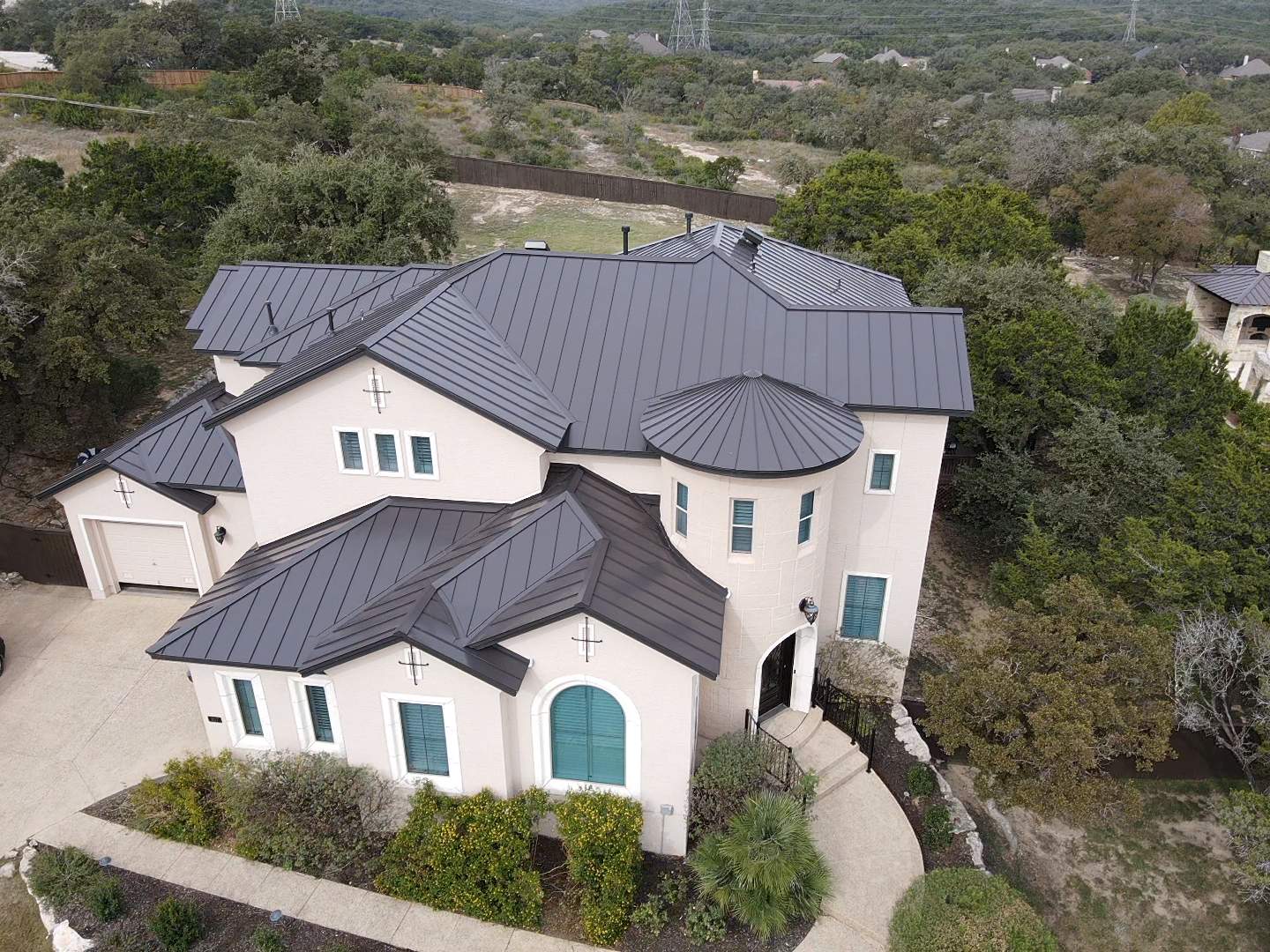
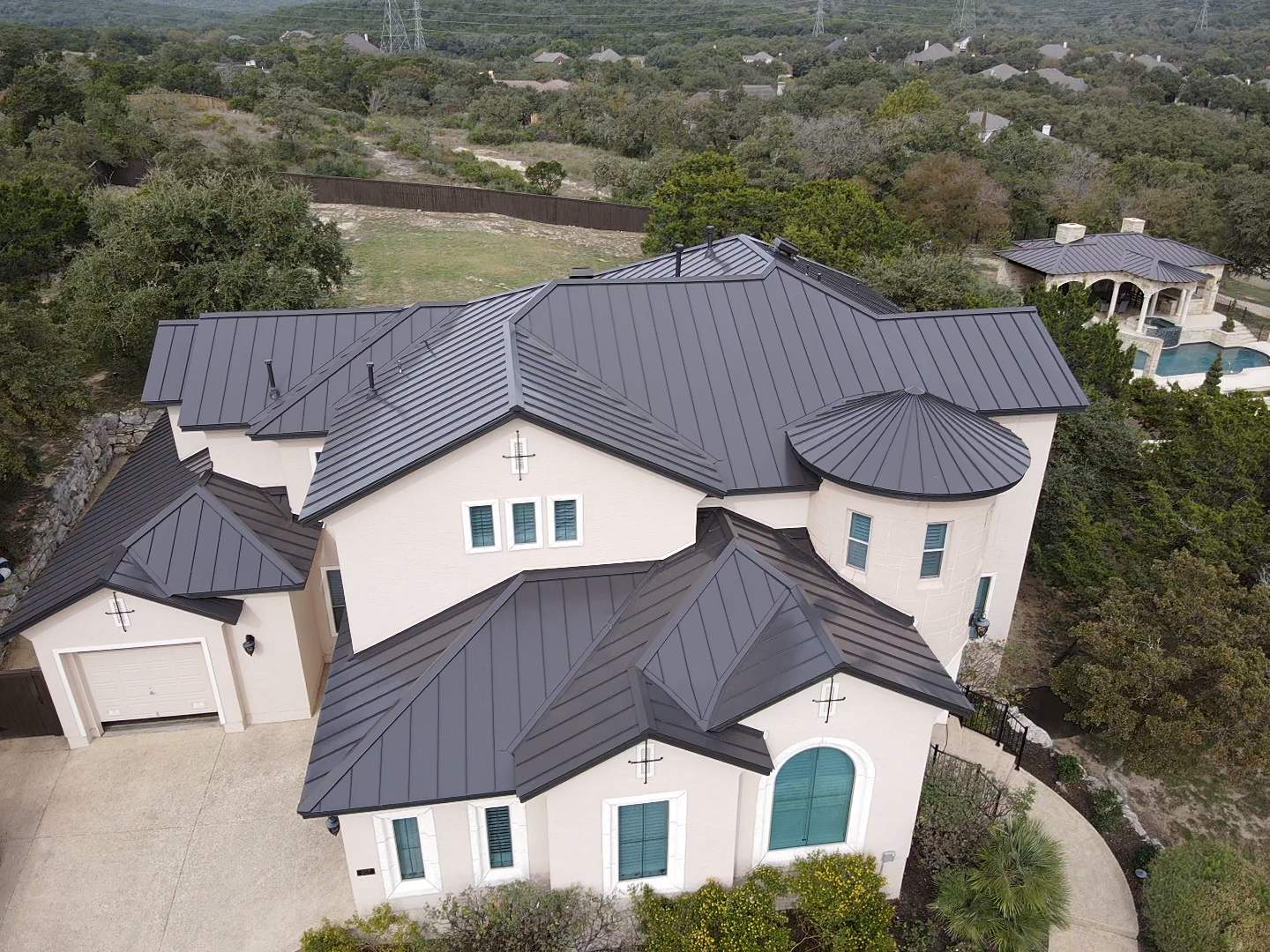
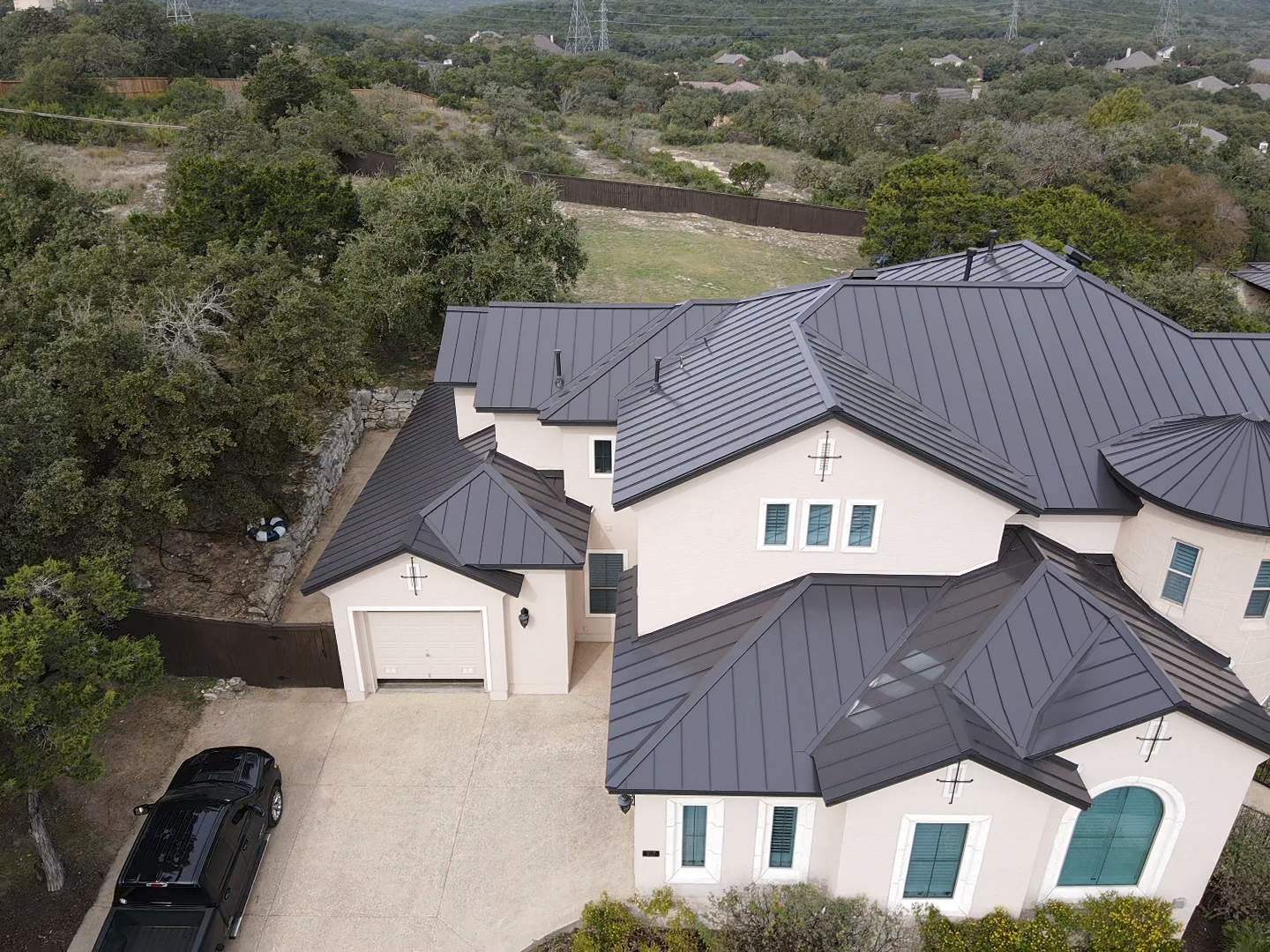
The scope covered it all under a single contract: complete concrete tile tear-off down to the decking, full deck replacement with 5/8″ Radiant Barrier OSB sheathing, High Temp Ice & Water Shield across the entire deck, and a McElroy 24-gauge Flat Profile 1.5″ Mechanically Fastened Standing Seam Metal roofing system installed across all 52 squares, covering all components, trim details, and flashings. That scope also included coordinating a stucco contractor to replace every counter flashing and wall flashing behind the stucco, plus two Breeze Solar Powered attic vents. The finished system is backed by a manufacturer warranty and a 10-year labor warranty.
Work Scope
Full tear-off of the existing concrete tile system down to the decking. Full deck replacement with 5/8″ Radiant Barrier OSB sheathing across the entire roof. High Temp Ice & Water Shield applied to the entire deck. McElroy 24-gauge Flat Profile 1.5″ Mechanically Fastened Standing Seam Metal system installed across the entire home, covering all components, trim details, and flashings. Stucco contractor coordination to replace all counter flashings and wall flashings behind the stucco. Two Breeze Solar Powered attic vents installed.
Challenge 1: Managing a Tile-to-Metal Conversion Without Splitting the Job Between Two Separate Crews
Concrete tile and standing seam metal are fundamentally different systems. The tradespeople who install them are typically different, too. The industry default when a homeowner converts is to bring in a tile crew for the tear-off and a separate metal crew for the installation. Two crews. Two scheduling tracks. Two sets of site coordination. Add the complexity of handing a job mid-stream between tradespeople who may have never worked together, and you’ve built in inconsistency: in how the site gets managed, how materials get handled, how problems get communicated when they come up. On a retail project at this scale and price point, those inconsistencies carry real risk.
The Solution: A Single Crew With Cross-Trade Expertise in Both Tile and Metal
Presidio’s crews are trained and experienced in both tile and metal roofing. That’s an uncommon combination, and it directly solves the handoff problem. After enough crossover work between the two systems across San Antonio, Presidio built the internal capability to run tile-to-metal and metal-to-tile conversions without splitting the workforce. One crew. One site superintendent. One chain of communication from tear-off to final inspection. No mid-project handoff. No divided accountability.
Challenge 2: Moving 52 Squares of Concrete Tile Off a Two-Story Roof Safely
Height changes the math on everything. Concrete tile runs between 1,000 and 1,500 lbs per square. On a 52-square roof, that’s between 52,000 and 78,000 lbs of material coming off the structure. At grade level, that’s a logistics problem. At two stories, it becomes a safety and equipment problem. The most serious risk is equipment collapse into the home, which happens from either using undersized machinery or overloading the basket of correctly-sized machinery. Most residential roofing contractors don’t own or operate equipment at this scale. Renting it without certified operators doesn’t reduce the exposure. It transfers it.
The Solution: A 12,000-lb Genie Telehandler With Certified Operators and Direct On-Site Coordination
The right tool for a job like this is a 12,000-lb Genie Telehandler with a 56-foot reach. That’s the upper end of what’s available on the market for this class of work. Presidio deployed that equipment here, operated by certified telehandler operators carrying commercial insurance coverage that extends to the client. But the equipment alone doesn’t make a job safe. The operational protocol does: direct, real-time coordination between the operator on the ground, the loader on the roof, and the site superintendent. That coordination prevents overloading, which is the single most common cause of telehandler incidents. Presidio has never had a telehandler failure. That record is built on a process that treats equipment operations as a managed risk, not a routine task.
Challenge 3: Flashing a Standing Seam Metal Roof Against a Stucco Facade Without Cutting Corners
Tile and metal roofs sit at different heights off the deck and have different profiles. That means the wall flashings from a tile system can’t be reused on a metal installation. On a stucco home, this creates an unavoidable problem: to properly flash the new roof at every wall intersection and penetration, you have to cut into the stucco. There’s no workaround. Any contractor who tries to reuse existing flashings on a conversion of this type is making a choice that will eventually produce a leak. On a $100,000-plus retail roof, that’s not a risk worth taking.
The Solution: Dedicated Stucco Contractor On Site to Restore Every Penetration Point
Presidio put stucco work in the contract as a required line item. Not optional. Not something the homeowner would coordinate separately. A stucco contractor was on site specifically to repair and re-stucco every area where the roofing crew had to cut, break, or manipulate the exterior walls to set the new flashings correctly. The finished roof is properly detailed at every wall transition: new flashings installed to the spec the metal system requires, stucco fully restored around each one. Any roofing company bidding a tile-to-metal conversion on a stucco home that leaves stucco coordination out of the scope is either planning to reuse the old flashings or putting that work on the homeowner. At this quality and price level, both are red flags.
The Result
The completed roof is a 52-square McElroy 24-gauge standing seam metal system across a two-story home: full deck replacement underneath, High Temp Ice & Water Shield across the entire surface, every wall and counter flashing properly set behind fully restored stucco. Delivered under a single contract. Done in 2-3 weeks on site. It carries a manufacturer warranty and a 10-year labor warranty. No carrier was involved. This was a straight retail project valued at $100,000-$120,000, which means every material and method decision was made on its merits. The homeowner told us the finished roof matched what they had in mind when they made the call to convert from tile. Read more from clients who’ve been through the same process.


How to Maintain Your New Standing Seam Metal Roof
While your new roof is built to last, regular maintenance ensures it remains eligible for warranty claims and performs optimally.
After any severe weather event, do a ground-level inspection. Look for dings in your gutters, tears in window screens, or broken, cracked, or displaced tiles. Don’t climb the roof yourself – call a professional if you suspect damage.
Keep gutters and downspouts clear at least twice a year and after major storms. Backups trap moisture and can damage your fascia, roof decking, and the tile system underneath.
Keep trees trimmed back at least 6-10 feet from your roof edges to cut down on debris and protect tiles from impact damage.
Frequently Asked Questions
What are the risks of hiring separate crews for a tile removal and metal roof installation on the same project?
How do roofing contractors safely remove heavy roofing materials from a two-story structure?
What equipment is required to remove concrete tile roofing from a multi-story home?
When converting from tile to metal roofing, does the existing flashing need to be replaced?
What happens to stucco when flashing is replaced during a roofing conversion?
How should a roofing contractor coordinate third-party trades on a complex residential project?
What is a retail roofing project, and how does it differ from an insurance-funded replacement?

About the author: Nick Van Slyke
Certifications & Affiliations