More than any other part of your home, your roof keeps your family safe from the elements outside. So it’s natural to want to insure your roof in case it’s damaged—particularly if you live in storm-prone Texas.
The age of your roof is one factor affecting the cost of your insurance rates. To simplify: the older your roof, the more you’ll generally pay. But that doesn’t tell the full story.
In this article, we’ll explain in detail:
- How the age of your roof impacts your insurance premiums
- What you can do to keep your insurance costs down if you have an older roof
- Other factors that affect your insurance rates beyond the age of your roof
Let’s get right into it.
Scenario 1: You have an older roof
As a general rule, the older your roof is, the more it will cost you to insure it.
Different insurance companies define “old” in different ways, but most premium insurance companies start viewing a roof as on the older side once it reaches 15 years old. At that point, premiums will typically rise by about 15%.
By the time a roof reaches 20 years old, you might be paying 30% more on your premiums each month, and that’s assuming you can even find a carrier at all. Roofs over 25 years old are very difficult to insure, since most insurers will turn them down.
Why is an older roof more expensive to insure?
Insurance companies view insuring older roofs as more risky—and with good reason. As roofs age, they become more prone to:
- Leaks
- Storm damage
- Structural problems
- Shingles breaking off
- Granular loss
All of these factors increase the likelihood that you, as a homeowner, will want to make a claim on your insurance. This is particularly true in regions that are prone to hail, snow, heavy rain or hurricanes, since these cause roofs to deteriorate more quickly.
Raising rates gives insurance companies more cash to fall back on in the case that you make a successful claim, and it also deters homeowners with excessively risky roofs from obtaining insurance in the first place.
Examples of age-related penalties
To offset their risk, insurers will do more than simply charge homeowners with older roofs higher fees.
As roofs age, insurers will often require homeowners to have supplementary documentation as a condition of providing insurance. For example, you might need to certify that you got your roof inspected in order to obtain a new policy, or renew your current one.
Once a roof reaches 20 years old, insurers will only insure you for the actual cash value (ACV) of the roof, meaning that you’ll only get back the value of the roof at the time that it was damaged—not the cost of replacing it. Given that the value of your roof will have depreciated significantly over 20 years, this isn’t likely to amount to much.
Insurers generally decline roofs that are over 25 years old, because at that point, they judge the risk of a claim to be too high. You can get around this issue by working with a specialty insurance company that only works with older roofs, but the cost of doing so is likely to be high.
Scenario 2: You have a newer roof
If your roof is 10 years old or less, you’re likely to pay less to insure it than you would an older roof. This is because insurance companies view newer roofs as less of a liability. There are a number of good reasons why insurance companies think this way:
- A roof is at its least likely to fail in the years immediately following its construction.
- Modern roofing materials are often more weather-resistant than older ones. For example, impact-resistant shingles can protect against hail damage, while metal roofs are less likely to suffer from wind uplift.
- A newer roof can reduce the risk of interior damage (mold, water intrusion, structural rot), which are some of the most expensive insurance claims to handle.
- New roofs are more likely to meet current building codes, including updated requirements for resistance to fire, wind and impact.
Examples of policies that favor newer roofs
Beyond charging homeowners with newer roofs lower premiums, insurance companies have numerous other ways of giving them favorable treatment. For example:
- They might offer a new roof discount of up to 30% to new customers who sign up with them.
- If a newer roof has eco-friendly upgrades like solar panels, insurers might offer further incentives, sometimes in partnership with benefits at the state or federal level.
- For properties that have older HVAC or electrical systems, insurance companies might be more lenient if they come with a newer roof, since it lowers the overall risk.
- If a new roof meets the standard to be certified as FORTIFIED, it could result in even more incentives being offered to the homeowner.
Other savings
Having a new roof can save homeowners money in other, less direct ways.
For example, having a new roof might mean you claim less on home insurance in general, resulting in lower premiums because of your squeaky-clean claims history.
You’re unlikely to be denied a claim due to poor maintenance if you have a newer roof, and you’ll also have to pay less each year in repairs.
Having an insurance-friendly roof might even make it easier to sell your property, and for a higher amount at that!
What can homeowners do if they have an older roof?
If your home has an older roof, it can be easy to feel like you’re at the mercy of insurers. While it is harder and more expensive on average to insure an older roof, there are some steps you can take as a homeowner to reduce your financial burden.
Get an inspection
Consider bringing in a licensed inspector to inspect your roof. A professional inspector will give you a detailed report about the state of your roof. If your roof is in good condition, that report will go down well with your insurance company, even if the roof is on the older side.
You might also think about joining a homeowners’ association that enforces roof upkeep with regular inspections. Not only will this keep you accountable; that sense of collective responsibility may also reflect positively when negotiating your premium.
Take proactive steps to maintain your roof
You can also impress your insurer by showing them that you’re serious about maintaining your older roof. For example:
- Consider installing hurricane straps or impact-resistant shingles as a way to mitigate against wind damage.
- Install a secondary water barrier beneath the shingles as an extra defense mechanism against leaking.
- Purchase smart home gadgets, like a leak detector for your attic or a sensor that monitors humidity near the roofline. Some carriers provide discounts for having these systems in place.
Even something as simple as regularly cleaning leaves off your roof, or replacing shingles that have come loose can prevent minor issues from escalating into something more serious.
Change the terms of your insurance agreement
Homeowners can also explore bundling their home insurance with auto or other policies. Bundling often leads to overall premium reductions, which can help offset the higher risk associated with an aging roof.
Another approach is to increase your deductible. Insurers may be more willing to provide favorable rates if you’re willing to take on a higher out-of-pocket cost in the event of a claim, even if your roof poses a higher risk due to age.
Other factors affecting insurance
Of course, the age of your roof isn’t the only factor affecting the size of your premium, as the following table shows:
| Factor | Lower premium | Higher premium |
|---|---|---|
| Materials | Metal or slate | Wood |
| Shape | Saltbox or hip | Flat or gambrel |
| Location | Mild climate | Prone to extreme weather |
| Documentation | Access to warranties, invoices and contracts | Missing paperwork |
| Condition of the roof | Well maintained | Missing shingles, algae, rust |
Let’s explore each of these factors in more detail.
Materials
From an insurer’s perspective, a roof made from durable materials is associated with lower liability. Robust, professional-grade roofing materials keep the elements out and degrade more slowly, reducing the chances that the insurer will have to pay out a claim.
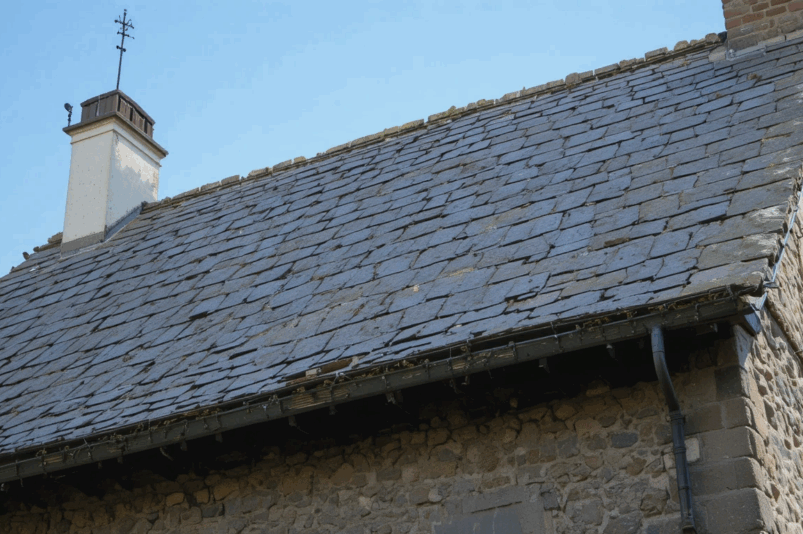
The cheapest roofing materials to insure are metal and slate. Roofs made from copper or steel alloys can last for up to 70 years, and are highly resistant to both fire and wind. Likewise, slate roofs are incredibly resistant to fire, rot and insects.
The most commonly used roofing material in America is asphalt shingles, so from an insurer’s perspective, this material is associated with their default pricing. Shingles decay more rapidly than metal and slate, but are still fairly durable. A homeowner with a roof made of asphalt shingles can decrease their premium by using shingles that are designed to be extra impact-resistant.
The most expensive type of roof to install is one made of wood, since such roofs are prone to fire damage. Some insurance companies will insist on a fire-retardant coating, while others won’t offer coverage at all.
Shape
Some roof shapes are more effective at stopping water from pooling than others. For example, a saltbox roof design is better at shedding water than a flat roof, where water is more likely to collect. This makes insuring flat roofs more expensive, on average, than insuring saltbox roofs.
By the same measure, some roof designs are more aerodynamic in high winds than others. A hip roof might be the best choice in a storm, while a gambrel roof is more likely to be damaged. Again, this makes insurers view hip roofs more favorably, especially in areas prone to storms.
Consider also the complexity of your roof design. Mansard roofs are so complex to build that repairs can be pricey—a cost that your insurance company is going to be less likely to want to expose themselves to.
Location
Insurers also consider where your home is located when calculating your premiums.
For example, homes located in areas prone to storms, hail, tornadoes, earthquakes or other weather events will cost more to insure than those that aren’t. If you live in an area prone to extreme wind, an insurance company might insist on wind mitigation features as a condition of your insurance contract.
Some areas are simply more expensive than others in general. A homeowner living in Beverly Hills is likely to pay a much higher premium than someone living in rural Utah, for example.
Even something like the crime rate in your local area can play a role in the rate determined by your insurance company. If parts of your home are at risk of being stolen, an insurance company is going to see that as a liability and charge you more.
Documentation
For homeowners looking to minimize their insurance rates, it pays to have the right documentation to hand.
Insurers commonly want to check paperwork like:
- Manufacturer warranties for your roofing materials
- Permits for previous work that was done to your roof
- Documentation proving that you hired a professional to maintain your roof
- Written evidence that you have complied with local building codes
These documents might seem pedantic to you, but to your insurer, they’re meaningful ways of managing the risk they take on when insuring you. So if you can show these documents to your provider, they’ll be grateful—and probably charge you less as a result.
Condition of the roof
A reputable insurance company will also check the condition of your roof before issuing you a quote. The better condition your roof is in, the more likely it is that they’ll want to work with you and provide you with a rate that’s good value for money.
When insurance companies inspect a roof, they’re specifically looking for early signs of damage, such as:
- Missing shingles or granules
- Streaks from water stains
- Moss or algae growth
- Rusted flashing around air vents
- Visible underlayment below the shingles
For homeowners’ insurance, the roof is just one part of their investigation of your home as a whole. Insurance companies are also interested in checking your electrical, plumbing and heating systems, since faults in these areas can lead to liability on their end.
Wrapping up
There are lots of factors that go into the rate that you get from your provider for homeowners’ insurance, but the age of your roof is certainly a major one. Newer roofs get lower rates, while roofs older than 25 years might not find coverage at all.
Fortunately, homeowners aren’t powerless in this situation. If you have a home with an older roof, it’s well worth while getting it inspected and maintained on a regular basis, and then providing documentation that proves that to your insurer.
At Presidio, our mission is to defend your home. So if you’d like one of our experts to come and inspect your roof, or give you some pointers about how to maintain it, give us a call today on (210) 686-6185. We’d be happy to help you.

About the Author
Certifications & Affiliations